Thursday, September 14, 2023

Back to School Edition: At What Point Do Accommodations Start Resembling Facilitated Communication?

Within local autism politics, I’ve become aware of an alliance between parents whose children are subjected to variants of facilitated communication (Spelling to Communicate and Rapid Prompting Method) and parents of higher-functioning autistic children, who aren’t. At first this alliance surprised me. Wouldn’t parents of verbal autistic children recognize how odd it is that facilitated children are able to output messages of much greater linguistic sophistication and social insight than those produced by their own children? That facilitated messages contain so many more metaphors and sophisticated social and psychological vocabulary words than unfacilitated messages produced by higher-functioning individuals who communicate independently? 

Compare: 

  • “The irony of a nonspeaking autistic encouraging you to use your voice is not lost on me.” (Facilitated)

  • “This fan is made by Halsey, and doesn't have a brand name anywhere on top of the motor housing or on the switch housing.” (Unfacilitated)

  • “My senses always fall in love: they spin, swoon;  they lose themselves in one another’s arms.  Your senses live alone like bachelors, like bitter, slanted rhymes whose marriage is a sham.” (Facilitated)

  • “Doing something fairly bad is only 3 and bad is 2 and very bad is 1.” (Unfacilitated).

Furthermore, why would parents of higher-functioning children who speak and type independently have any vested interest in believing that facilitated communication, despite all the evidence against it, is valid?

The more I’ve thought about this, however, the more sense it makes to me that parents of unfacilitated autistic children not only are susceptible to believing in FC, but actively support those whose children use it.

First, developments in the last few years reveal that large numbers of people are gullible, including major media outlets (see our FC in the media tab), the National Institutes of Health, and numerous autism experts. There’s little reason why parents of unfacilitated high-functioning autistic children should be any different.

Second, some parents of unfacilitated high-functioning children request accommodations that, while not going nearly as far as FC does, nonetheless lean towards FC. That is, while the sought-after accommodations mostly do not substitute the words of the student’s helper for the student’s own words, they do go a certain distance in that direction. And while the rationale behind these accommodations does not assume that there’s a verbally normal-to-way-above-normal mind locked inside a non-speaking individual, it often presupposes something similar.

Luisfer Valenzuela, via Wikimedia Commons

Many parents of unfacilitated autistic children, like the parents of facilitated children, are eager to get their kids out of special ed classes and into general ed classes, or (where possible), honors classes. Many would like to believe that, with proper academic accommodations, their children can handle honors-level assignments. This is particularly true in wealthy suburbs, home to some of the most competitive parents: people with the motivation and means to choose where to live based on the reputation of the local schools, particularly their honors programs. For many of these parents—whether or not their kids have special needs—failing to get their children into honors classes (as some have told me outright) is an embarrassment, a badge of shame—as much for the parents as for their children.

In other words, my child is at least as highly intelligent as his peers and just needs proper supports to allow that intelligence to emerge.

What about the supports themselves?

These include several that have what we might call “FC-adjacent” connotations and implications:

  • Pictures and wordbooks to guide the child’s writing. The rationale is not that the child doesn’t know the words and their meanings, but that she simply has trouble retrieving them from memory. In other words, the words are there but are locked inside. Proponents of FC often use retrieval difficulties as an excuse for message-passing failure; RPM proponents also evoke it as justification for the facilitator’s prompts.

  • Alternative ways of “demonstrating understanding.” In lieu of an essay, for example, a child might produce an illustration or cartoon. The rationale is that all kids understand: it’s just that some need a customized way of outputting that understanding. For some, it is a picture; for some, a travel brochure; for some, a puppet show; for some, extra time and/or a smaller “sample”, or subset, of the assigned work; for some, the option to retake a test of up to three times; for some, an aide who makes sure they understand directions, assignment prompts, and test questions, helps them organize their ideas, and keeps them on task; for many, some combination of all of the above. Especially when it comes to aides, who often end up (sometimes unintentionally or even unwittingly) doing a lot of the work for the student, it’s not too many steps to a facilitator holding up a letterboard.

  • Outlines, keywords, and study guides (guides that often must contain everything that might later appear on a test). The rationale, again, is that while all kids have the linguistic skills to understand what they read and what’s discussed in class, some need help with organization and attention. This recalls another justification for the RPM facilitator: helping a distracted child stay organized and on task.

  • Fill-in-the blank and multiple-choice questions instead of long-answer questions; a reduction in multiple choices from 4-5 to 3 or 2; the option to indicate choices with an index finger rather than filling in the bubble. Rationale: some students may have difficulty with expressive language but still understand the academic content; some may have handwriting or other motor difficulties that undermine their ability to answer long-answer questions or fill in or circle bubbles; some find too many multiple-choice options overwhelming. A child pointing to one of two or three multiple-choice answers recalls the initial stages of RPM, in which a child “demonstrates understanding” by pointing to one of two held-up fragments of paper with words on them.

These accommodations aren’t specific to honors classes or general education; they also routinely occur in special education classes, especially when students take state-mandated tests. Nor are competitive parents the other underlying factors.

The other players are the Powers that Be in the education world. These folks believe—or want the rest of us to believe—that academic goals should be based exclusively on students’ calendar ages. Only those with extreme cognitive disabilities—about 1 percent of the population—are exempt. Everyone else, the Powers that Be feel (or want the rest of us to feel), have it in them to meet these goals, so long as they are given adequate supports to demonstrate and output their understanding. The Powers that Be, in other words, are allied with many (though by means not all) special needs parents.

Second, there’s the reality of special education classrooms. Ideally, such settings allow tailored instruction optimized for each child, delivered via a much lower student-to-teacher ratio. In reality, many of these classrooms are hampered by a highly heterogeneous array of special needs that are hard even for the most talented, dedicated teachers to address simultaneously, and by the often highly unrealistic expectation that the teachers focus, not on material within their students’ zones of proximal comprehension, but on the one-size-fits-all goals for all students that happen to have the same calendar age. This, naturally, has many special ed parents, not just FC parents, thinking that a general education classroom with an aide and lots of accommodations might be preferable.

What all this leads to, at least among the more well-resourced, aspirational parents, is a broader alliance with broader goals than just FC parents promoting FC. And the bigger picture, in many quarters, is a Lake Wobegon scenario in which all the kids are above average. 

It’s just that some of these kids need extra support and facilitation in order for this to come to light.

REFERENCES AND FURTHER READING

Beech, M. 92010). Accommodations: Assisting Students With Disabilities. Learning Systems Institute Florida State University Bureau of Exceptional Education and Student Services Florida Department of Education Third Edition. https://files.eric.ed.gov/fulltext/ED565777.pdf

Florida Department of Education Bureau of Exceptional Education and Student Services and Division of Community Colleges and Workforce Education. (2005). Accommodations and Modifications for Students with Disabilities in Career Education and Adult General Education, https://cdnsm5-ss15.sharpschool.com/UserFiles/Servers/Server_70176/File/Academics%20&%20Curriculum/Subjects/ESE/ese311201_acmod-voc.pdf

Hipsky, S. (2011). Differentiated Literacy and Language Strategies for the Elementary Classroom. Pearson.

Strauss, V. (2015, March 20). ‘You do not speak for our children.’ The Answer Sheet. Washington Post.

Wednesday, September 6, 2023

Should professors embrace ChatGPT and other LLMs?

Ethan Mollick, a professor at the University of Pennsylvania Wharton School, thinks we should. In fact, he requires it, at least for certain assignments. Importantly, he also requires students to fact-check everything ChatGPT writes and holds them responsible for any errors they don't catch. He also provides students with guidelines about how to use Chat: specifically, how to ask it questions that produce useful responses. "More elaborate and specific prompts work better," he notes. He also offers suggestions on how to deal with the fact that Chat runs out of memory after about 3000 words.

Telling, the subtitle of the article that describes his approach is "A professor at the University of Pennsylvania embraces AI use in all his classes and has seen an increase in student success rates."

To some extent, this isn't surprising. Catherine Johnson and I have been looking at lots of output from ChatGPT and other LLMs and have found that most sentences are highly readable and well-connected. LLMs probably produce better prose than many people do, especially as a first draft (and I'm guessing that few people these days bother to go back and revise, especially when they have autocorrect and Grammarly catching many of their most egregious errors).

But LLM's are bad at other aspects of writing. All the sentences are about the same length and rotate through just a few sentence structures. Same with the paragraphs. The vocabulary tends toward the abstract, and the default tone is anodyne, wishy-washy, and preachy. Even if you suspend disbelief, you never feel like a real person is talking to you, anticipating your assumptions and questions and addressing them at just the right moment.

Mollick does note that "[p]roducing good AI-written material is not actually trivial." But his focus isn't on punching up the prose to make it more interesting and conversational, but on tweaking the prompts that generate the output. Post-production editing, for Mollick, appears to be limited to fact-checking the content.

As Molluck notes, "as a tool to jumpstart your own writing, multiply your productivity, and to help overcome the inertia associated with staring at a blank page, it is amazing." But is that how most people are using it? What if it's used, not just as a jumpstarter and brainstorming aide, but also as an articulator, organizer, and synthesizer.

The article asks: "Will the chatbots' technical proficiency make learning certain skills for humans obsolete?" But doesn't ask the follow-up question: will chatbots reduce people's motivation to go through what is perhaps the only process for learning certain skills--thinking skills, thought-articulation skills, thought-organizing skills, thought-connecting skills--namely, the process of putting one's thoughts in writing, from scratch, and synthesizing them into something new and interesting?

Thursday, August 31, 2023

How might touch reduce the cognitive load of FCed typers?

Proponents of facilitated communication—specifically, of the classic, touch-based variant of FC—have come up with all sorts of reasons for why facilitators need to hold the wrists, arms, or other body parts of facilitated individuals while they type.

Per FC proponents, physical touch is used to

  • provide physical stabilization (e.g., for tremors in the arm or finger)

  • give tactile feedback (for those with deficits in body awareness)

  • pull back or slow down the person’s typing hand (to prevent perseveration on letters and on letter sequences)

  • keep typers calm and focused

  • ·express emotional support.

Excluded from this list, of course, is the real reason for physical touch in FC: namely, that touch is how facilitators (however unwittingly) control the typed-out messages—i.e., by cueing the facilitated individuals about which letter to select.

In a recent article in Frontiers in Neuroscience, FC proponents[1] offer a novel justification for touch in FC (Nicoli, Pavon, Grayson, Emerson, & Mitra, 2023):

  • reducing the “cognitive load” of the typer.

In particular, the authors declare, FC may reduce the typer’s “sensorimotor workload… thereby freeing up shared cognitive resources for the linguistic elements of the task.” The source of the sensorimotor workload? “Typing while sitting.”

Rodrigo O. Sanchez, CC BY-SA 3.0, via Wikimedia Commons

The authors spend about 3000 words describing the myriad sensorimotor and complexities of typing while sitting—complexities that, though I am at this very moment doing precisely this (typing while sitting) I had no idea of. The next 2000 words discuss how concurrent motor and cognitive tasks like typing while sitting can potentially undermine one another (i.e., typing potentially undermines sitting, and sitting potentially undermines typing): a consequence of the cognitive resources they share, particularly in people with limitations in executive functioning (planning, working memory, and control of attention).

The next thousand words explain how touch can help with the postural control required when people type while sitting, “thereby reducing cognitive load” and freeing up resources for typing out appropriate, linguistically well-formed messages. The authors acknowledge that non-humans could also provide cognitive-load-reducing touch, as with the back of a chair or a robotic arm (they cite Oudin, 2007’s report of assisted typing via a mechanical arm, which Janyce discusses here). But only humans, they claim, can optimize the effects of touch by adjusting to shifts the typer makes in his posture or sitting position. Of course, humans are also better at unwittingly cueing linguistic messages than either mechanical arms or chair backs are.

The authors’ next two thousand words describe how developmental disabilities are associated with sensorimotor deficits and difficulties with executive functioning. A final section concludes that the facilitator’s touch may serve to free up cognitive resources for linguistic expression, or, in their words: “supportive touch might reduce the computational workload of generating and typing linguistic content by assisting the sensorimotor processes of typing.”

For all their extensive and seemingly comprehensive discussion of sensory-motor challenges, executive functioning challenges, and the presence of these challenges in individuals with developmental disabilities, nowhere do the authors mention the language and literacy challenges that also commonly come with developmental disabilities. Nowhere do the words “language,” “vocabulary,” “grammar,” “syntax,” or “literacy” appear. The word “word” is used only in the context of typed words; the word “linguistic” is used only to describe tasks and output, not difficulties; and the word “spelling” is used only in connection with tasks and recall, not in connection with whether a person actually has any spelling knowledge to recall.

Instead we get ruminations like:

Deficits in planning would limit the strategies available for organizing the content to be typed (narrating an event, answering a question…), deficits in verbal fluency would impair finding the lexical target of a conceptual referent, and working memory impairment would influence typing effectiveness at the sentence and word level. People with executive dysfunctions may find it difficult to maintain the to-be-typed sentence, or even the graphemic string…

The assumption, of course, is that non-speaking, developmental disabled individuals who depend on facilitation, however deficient their planning skills, however dysfluent their language, still have the linguistic ability to narrate events, answer questions, comprehend “lexical targets,” construct sentences, and sequence graphemes (letters) into words.

Nor do the authors mention the most likely way in which supportive touch might reduce computational workload: namely, by cueing the facilitated individuals about which letters to type. Such cues, experiments have shown, are ones that facilitators cannot help but convey, even if they’re completely unaware of doing so (see Spitz, 1997 for a review). This means that the most likely effect of supported touch is to free a facilitated person’s cognitive resources, not for the linguistic elements of the task, but from the linguistic elements of the task. The supportive touch, in other words, keeps the facilitated person from having to do any linguistic work at all.

Nor do the authors themselves do much linguistic work. Instead of discussing the various linguistic challenges that are likely to limit non-speakers with developmental disabilities, they expend their cognitive energies elsewhere, dazzling us with passages like these:

Visual information is particularly salient in the detection of self-motion as movements of the head through a visible environment generate flows of optical elements across the entire visual field (Lee and Lishman, 1975; Dijkstra et al., 1992). Anterior-posterior head motion produces radial optical flow whereas medial-lateral head motion generates lamellar flow (Warren, 2010). When these visual signals are available, the body sways less in both planes (Edwards, 1946; Paulus et al., 1984, 1989). Indeed, the ratio of body sway between eyes-open and eyes-closed conditions, the Romberg quotient, is a clinical indicator of postural stability (Romberg, 1853). Research suggests that the maintenance of balance (for example, keeping the body’s center of mass within the base of support) involves both exploratory and corrective body sway. Exploratory sway generates perceptual information (including optical flow) that guides the compensatory sway that corrects drifts toward instability (Riccio et al., 1993; Riley et al., 1997).

Dazzling the reader—and perhaps also the journal editors—with thickets of technical terminology and high-level concepts is reminiscent of Jaswal et al. (2020)’s pro-FC eye tracking paper. Head-mounted eye trackers, meticulous codings of hours of video, graphs of anticipatory eye gaze fixation patterns—all instead of a simple, low-tech message-passing test that would have settled matters once and for all.[2]

This paper’s introductory lit review, at least, acknowledges the long legacy of message-passing failures. But none of its subsequent claims about supportive touch can explain why facilitation fails when the facilitator doesn’t know what the facilitated person’s response should be. How, for example, would the facilitator’s touch fail to reduce cognitive load in cases where the facilitator hasn’t seen the image that the facilitated person is being asked about? The most this paper could explain, assuming its (untested) hypotheses are true, is why facilitated individuals are unable to type without the support of facilitators. But in no way does this explanation rule out facilitator control of letter selection. Indeed, as the authors themselves acknowledge: “The existence of the presented pathway for cognitive load reduction does not negate the possibility of specific cueing by the facilitator’s touch.”

But then they go on to propose that the most likely effects of the facilitator’s touch on the FCed person’s typing is a “co-creation” process that is analogous to someone who helps a mobility-impaired person walk, or to the scaffolding provided by a teacher in helping a student complete a not-yet-fully-mastered task.

Such analogies, however, collapse under scrutiny. A mobility-impaired person, assuming she can communicate independently, can tell you if you’re directing her somewhere she doesn’t want to go. And most students routinely undergo un-facilitated testing that establishes what they can do on their own. But when what’s being facilitated—and, quite likely, facilitator-controlled—is communication itself, and when facilitators and parents routinely refuse to allow un-facilitated (or facilitator-blinded) testing, there are no safeguards against “supportive touch” extending beyond mere support to out-and-out control.


NOTES

1. The two lead authors, Giovanni Nicoli, Giulia Pavon, are both members of, and received funding from, Vi Comunico Che Penso, described in the article as “a charitable organization whose mission includes supporting the development of facilitated communication.” Two other authors, Andrew Grayson and Anne Emerson, have a track record of pro-FC writing (see, e.g., Emerson, Grayson, & Griffiths, 2001). All five authors hail from Nottingham-Trent University, also home to Matthew Belmonte, another FC proponent.

2. Unsurprisingly, the authors reference Jaswal et al.’s paper: “Others have used eye-tracking methods (Grayson et al., 2012; Jaswal et al., 2020) to show that users anticipatorily fixate the to-be-typed key, and so are actively involved in the process.” More surprisingly, they cite FC critiques as sources on the use of FC to support typing: “A number of techniques seek to assist individuals with DD to type text on a keyboard or to point to textual or pictorial information on a screen by providing them with supportive touch on the torso or arm (Lilienfeld et al., 2014; Schlosser et al., 2014; Beals, 2022).” We are left wondering whether they actually read these articles.

REFERENCES

Emerson, A., Grayson, A., and Griffiths, A. (2001). Can’t or won’t? Evidence relating to authorship in facilitated communication. International Journal of Language & Communication Disorders, 36 (s1), 98-103. DOI: 10.3109/13682820109177866

Jaswal, V. K., Wayne, A., and Golino, H. (2020). Eye-tracking reveals agency in assisted autistic communication. Scientific Reports. 10:7882. doi: 10.1038/s41598-020-64553-9

Nicoli G, Pavon G, Grayson A, Emerson A and Mitra S (2023) Touch may reduce cognitive load during assisted typing by individuals with developmental disabilities. Frontiers in Integrative Neuroscience 17:1181025. doi: 10.3389/fnint.2023.1181025

Oudin, N., Revel, A., and Nadel, J. (2007). Quand une machine facilite l’écriture d’enfants non verbaux avec autisme. Enfance 59, 82–91.

Spitz, H. (1997). Nonconscious Movements: From Mystical Messages To Facilitated Communication. Routledge.

Friday, August 25, 2023

Research on camouflaging in autism is built on sand

 A recent article, entitled Camouflaging in autism: A systematic review, reviews 29 studies that examine the purported tendency among autistic individuals to hide their autism in order to fit in with broader society. Given that autism is a social disorder, and that fitting in socially involves social skills, this notion has always rung false to me. I imagine it rings false to most parents as well, except perhaps for a few whose children have extremely mild symptoms to begin with.

This meta-analysis uses two measures for establishing the existence of camouflaging: self-report, and what it calls "internal-external discrepancy."

Self-reports are highly problematic. First, they're notoriously unreliable. People are often inaccurate when reporting on their motivations and behaviors: few of us know what our real motivations are, nor do we often have an accurate sense of how our behaviors come across to others. 

Second, as far as autism is concerned, those able and willing to fill out self-reports are at the mildest end of the spectrum--both in terms of language skills (able) and in terms of social motivation (willing). This limits any conclusions about camouflaging in autism to a sliver of the spectrum. The diminished social awareness that occurs even within this high-functioning sliver, furthermore, may add another layer of inaccuracy to the self-reporting.

So what about "internal-external discrepancy"? According to the authors, this means "quantifying the difference between an individual's ‘true’ autistic state and their observable behavioural presentation." But their only references on how this could possibly be measured are two papers by Lai et al. (2017 and 2019)--papers that, surprisingly, are not included in their references.

However, I managed to track down Lai et al. (2017) and Lai et al. (2019), and learned that they measure camouflaging as:

the quantitative discrepancy between the person’s ‘external’ behavioural presentation in social–interpersonal contexts (measured by the Autism Diagnostic Observation Schedule) and the person’s ‘internal’ status (dispositional traits measured by the Autism Spectrum Quotient and social cognitive capability measured by the ‘Reading the Mind in the Eyes’ Test).

But, too, is problematic. As its name suggests, the Autism Diagnostic Observation Schedule is a diagnostic tool, so it is supposed to be a measure of autism, not of the camouflaging of autism. And the Autism Spectrum Quotient is... another highly problematic self-rating tool.

Most of us camouflage, to some extent; whether individuals with autism, even at the mildest end of the spectrum, do so more than the rest of us do is a question that remains unanswered, including by the studies that purport to address it.

Tuesday, August 22, 2023

Right-brained science: the myth of the finches

Behold Albert Einstein: not the tidy young patent clerk, working through his most groundbreaking theories, but the scraggly eccentric of his later years. This image speaks volumes about our conception of scientific geniuses. We view those we most admire more as crazy, intuition-driven, mold-breaking, wild-haired artists than as meticulous researchers and rigorous analyzers. We imagine their greatest mathematical and scientific breakthroughs occurring not at desks or in laboratories; instead, we see Archimedes in his bathtub, Newton under and apple tree, and Franklin in a storm with his kite.

From an early draft of Raising a Left Brain Child in a Right Brain World, then called "Out in Left Field in a Right Brain World."

I regretted eliminating this section; it didn't fit in with the publisher's re-conception of my project as a parent-oriented advice book rather than as a broader cultural critique. But the more I think about it, the more I think that this right-brained conception of science and scientists has contributed to the demise of science education in ways that specifically shortchange left-brained, scientific minds.

--The notion that the way you get kids interested in science is to showcase the epiphanies rather than the puzzle solving--downplaying the importance, and the fun,
 of solving hard puzzles.

--The notion that the way to prepare kids for science careers is to promote "creativity" and "out of the box thinking" rather than the analytical and mathematical skills that scientific competence depends on.

So it was nice to come across an old Op-Ed by physicist Leonard Mlodinow
. As soon as I read the first two paragraphs, I knew just what he was getting at:

The other week I was working in my garage office when my 14-year-old daughter, Olivia, came in to tell me about Charles Darwin. Did I know that he discovered the theory of evolution after studying finches on the Galápagos Islands? I was steeped in what felt like the 37th draft of my new book, which is on the development of scientific ideas, and she was proud to contribute this tidbit of history that she had just learned in class. 

Sadly, like many stories of scientific discovery, that commonly recounted tale, repeated in her biology textbook, is not true.

Noting that "The popular history of science is full of such falsehoods," Mlodinow writes:

The myth of the finches obscures the qualities that were really responsible for Darwin’s success: the grit to formulate his theory and gather evidence for it; the creativity to seek signs of evolution in existing animals, rather than, as others did, in the fossil record; and the open-mindedness to drop his belief in creationism when the evidence against it piled up.

The mythical stories we tell about our heroes are always more romantic and often more palatable than the truth. But in science, at least, they are destructive, in that they promote false conceptions of the evolution of scientific thought.

Of the tale of Newton and the apple, the historian Richard S. Westfall wrote, “The story vulgarizes universal gravitation by treating it as a bright idea ... A bright idea cannot shape a scientific tradition.” Science is just not that simple and it is not that easy.

Perhaps most compelling is Mlodinow's critique of a Steven Hawking movie:

In the film “The Theory of Everything,” Stephen Hawking is seen staring at glowing embers in a fireplace when he has a vision of black holes emitting heat. In the next scene he is announcing to an astonished audience that, contrary to prior theory, black holes will leak particles, shrink and then explode. But that is not how his discovery happened.
In reality, Mr. Hawking had been inspired not by glowing embers, but by the work of two Russian physicists. 

According to their theory, rotating black holes would give off energy, slowing their rotation until they eventually stopped. To investigate this, Mr. Hawking had to perform difficult mathematical calculations that carefully combined the relevant elements of quantum theory and Einstein’s theory of gravity — two mainstays of physics that, in certain respects, are known to contradict each other. Mr. Hawking’s calculations showed, to his “surprise and annoyance,” that stationary black holes also leak.

Not glowing embers; difficult mathematical calculations.

Mlodinow notes that "the oversimplification of discovery makes science appear far less rich and complex than it really is." He also touches on broader consequences:

Even if we are not scientists, every day we are challenged to make judgments and decisions about technical matters like vaccinations, financial investments, diet supplements and, of course, global warming. If our discourse on such topics is to be intelligent and productive, we need to dip below the surface and grapple with the complex underlying issues. The myths can seduce one into believing there is an easier path, one that doesn’t require such hard work.

To see this in action, one need look no further than the education world--including, of course, the subworld of science education.

Friday, August 18, 2023

Spellers but not Readers? Do facilitated individuals ever read books?

 (Cross-posted at FacilitatedCommunication.org.)

Let’s begin with an authorship-to-readership syllogism:

  • For a message to be authored by someone, it must be understood by that person.

  • For a typed message to be understood by that person, the words must be words that person can spell.

  • If someone can spell words, then they should be able to read them.

  • Therefore if those undergoing facilitated communication are the authors of the sophisticated messages that are attributed to them, they should be able to read messages of similar sophistication.

So why, in all the images and videos of individuals who are subjected to one or another version of facilitated communication (FC, RPM, S2C), do we never see these people reading; only being read to by others?

Here, for example, is Carly Fleischmann, a non-speaking autistic person who can only type messages with a designated helper sitting within auditory and visual cueing range, being read to by her father.

This image comes from a 20/20 segment featuring Carly Fleischmann (posted in 2012 on YouTube). In this video, starting just after 2:40, we see Carly’s father reading to Carly from Love in the Time of Cholera:

 [T]he room resembled a ship’s cabin, its walls…

The reading is interrupted with a voiceover attributed to Carly that is also displayed on a screen:

Dear Dad, I love when you read to me. And I love when you believe in me. I know I am not the easiest kid in the world. However you are always there for me, holding my hand and picking me up. I love you.

If Carly is the author of the above message, and if she understands her father’s spoken words when he reads out loud to her, what’s preventing her from reading Love in the Time of Cholera to herself? Or, at least, the Twilight Series or Harry Potter?

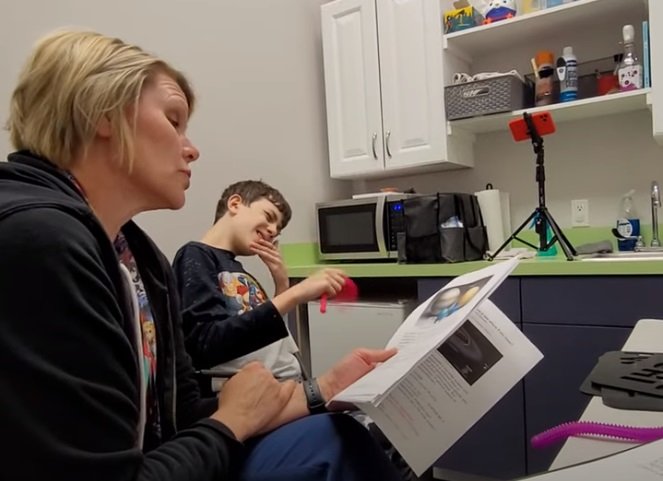
Next we have Joey, a non-speaking autistic boy being read to by an S2C clinician from a handout called “The Kuiper Belt: What is it like where Pluto lives?”, as we see in this “S2C lesson” posted to YouTube:

PLUTO was considered one of nine planets in the solar system until 2006 when it was RECLASSIFIED (assigned to a different class or category) as a DWARF planet. It confused and saddened many people why Pluto was EVICTED (moved or forced out) from planet status. But something had to be done following the discovery of several other objects of planet size in the KUIPER BELT (pronounced Ky-per). [The capitalized words are spelled out by the clinician after she reads them.]

(For Janyce’s analysis of this video, see here.)

In answer to various questions about the passage, Joey points to letters (albeit with a great deal of prompting, board movement, board switching, and initially faulty letter selections) the spell the words “planet,” “Pluto,” “dwarf”, “Kuyber belt,” and “evicted.”

Finally, here is Dawnmarie Gaivin (from a scene in Spellers) reading to two boys who purportedly spell to communicate via S2C:

The East Coast-West Coast hip hop rivalry was essential a feud between Bad Boy Records and Death Row Records. Oakland-based Rapper Tupac Shakur then kicked off the rivalry with Biggie by alleging that he and Puff Daddy were behind Tupac being robbed and shot five times in the lobby of a New York recording studio. Biggie’s track Who Shot Ya was released soon after Tupac’s attempted murder, although Bad Boy Records denied involvement and claimed the song was recorded months prior to the incident. Still the hip-hop community interpreted it as a taunt at Tupac.

In response to this reading, one of the boys purportedly types, in response: “Gross. I agree that’s f***ed up,” and the other (albeit with lots of prompting, physical obstruction, and board movement), “The gross part is his smirk while planning Tupac’s demise.”

Nowhere in Spellers, or in any other FC documentaries (The Reason I Jump, Deej, Autism is a World), or in any of the FC-promoting videos on YouTube, do we ever see the eyes of a facilitated person scanning letters arranged meaningfully into words and sentences in books—for all the times we see their index fingers pointing at letters arranged in alphabetic rows on boards.

The only discussion of what reading in FCed individuals looks like, so far as I know, is in Portia Iversen’s memoir Strange Son (the source of so many unwittingly revealing revelations about FC). Consider what Iversen writes of Tito Mukhopadhyay, the purported author of sophisticated email messages, poetry, and philosophical musings, as well as a published book:

When I visited their apartment, I often found Tito just sitting there on the couch with the same blank expression on his face. Didn’t he get terribly bored, just sitting there, unable to read a book on his own, unable to turn on the radio or TV, unable to do anything at all? (p. 117; emphasis added here and below).

(Since 2006, when Portia’s book was released, nine additional books have come out attributed to Tito.)

Elaborating further, Iversen reports, with reference to Soma Mukhopadhyay, Tito’s mother and RPM’s “inventor”:

Tito preferred to be read to… Yet in spite of the cognitively and academically advanced material Soma read to Tito, she would only read a few sentences at a stretch to him, followed by questions. (p. 185)

The RPM-generated answers to these questions purportedly indicated that “Tito could absorb and comprehend the material quite well.”

As for Tito’s own reading habits, Iversen reports:

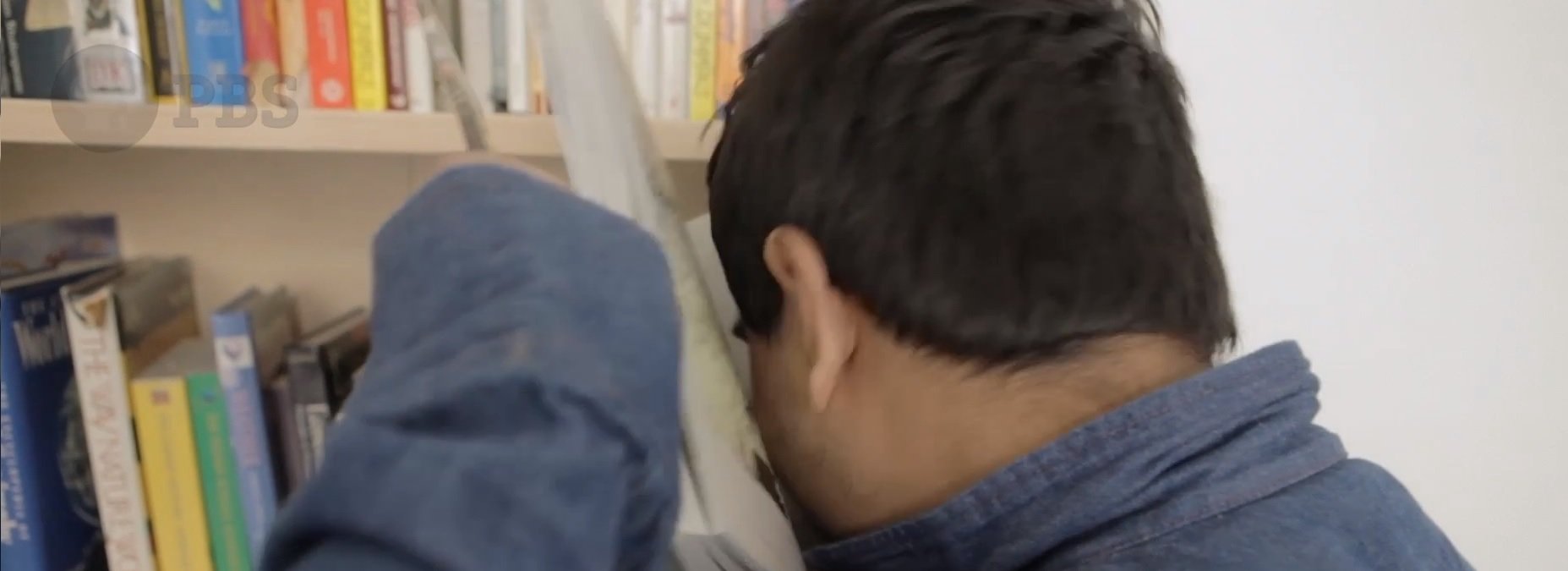
He would glance at the page when prompted by his mother and afterward could answer questions about the content. That meant he could read silently to himself, but not unassisted. Not surprisingly, another obstacle was that Tito could not initiate reading on his own, just as he was unable to pick up his alphabet board or pen and paper, or go to his laptop to initiate communication. But perhaps the most insurmountable barrier to Tito’s reading independently was that he could not physically handle a book by himself in such a way that it could actually be read. Not only could he not scan the words with his eyes without the guidance and prompting of his mother but he could not even turn the pages in an ordinary way and would quickly revert to stimming on the pages, flipping them back and forth in front of avidly sniffing them. (pp. 185-186)

At around 1:50 on this PBS video, a slick promotional video for Tito and his sensory experiences, we see him doing just that.

As to the question of whether Tito himself can read out loud:

[T]he answer was yes—sort of. Soma tried to teach Tito to talk by having him read with her... Later Tito graduated to reading aloud without his mother’s voice accompanying him, but still Soma had to initiate for him, hold the book for him, turn each page, turn each page, and prompt each word that he read aloud… (p. 186)

As Tito himself purportedly reported (via RPM):

[It] was much harder for him to comprehend what was written by any method other than listening. He explained that this was because the struggle to read aloud or silently demanded so much effort that it was extremely distracting and diminished the attention he could focus on understanding the text. (p. 186).

The reason, Iversen writes in an appendix to Strange Son, is that Tito is an “auditory learner” and “when the auditory-type child fails to develop speech, he is usually surrounded by the very visual materials that he can’t process.” (p. 6). Besides the evidence against learning styles in general and “auditory learners” in particular, the question, of course, is why an auditory learner would find it easier to type than to speak.

Then there’s Portia’s own son, Dov. As Iversen reports, Dov would glance only “fleetingly” at pages when directed to read but, through RPM, could accurately answer reading comprehension questions about increasingly difficult books (p. 310).

Setting aside the questionable validity of Dov’s RPM-delivered answers, is it possible to read pages of text through fleeting glances?

Actual reading—reading for meaning—requires sequential word-by-word, line-by-line eye fixations. As Seidenberg explains in Language at the Speed of Sight (p. 70), reading speed is limited by the following factors:

About seven to eight letters are read clearly on each fixation

Fixation durations average around 200 to 250 milliseconds (four to five per second).

Words in most texts are about five letters long on average.

4 fixations per second = 240 fixations per minute

240 fixations X 7 letters per fixation = 1,680 letters per minute

1,680 letters / 6 (five letters per word plus a space) = 280 words per minute

Assuming an average of somewhere around 250 words for a full page of text (see estimates given here), experienced readers, for full comprehension, have to spend close to a minute looking at a page. (For discussion of how full comprehension allows minimal word skipping, see Seidenberg, pp. 71-73). Illustrated books for less experienced readers might require less sustained page gazing, but “fleeting glances” simply won’t cut it. Nor does just gazing: the eyes must move back and forth, left to right, line by line, fixation by fixation.

Ay, but there’s a rub. Somewhere in FC Land I hear voices reminding me that FCed kids are geniuses. How do I know that they aren’t actually “visual thinkers” with photographic memories that allow them to “take a picture” of a page of text, look away, and then read the page in their heads—perhaps in ways that are invisible to others?

There are two problems.

First, the person asking comprehension questions would have to allow enough time between the fleeting glance at the page and the response to the comprehension question for the FCed person to have been able to read the words in the picture of the page in his or her head, which would still require eye fixations at four fixations per second, etc., and therefore still require close to a minute per full page of text.

Second, there’s no evidence that photographic memory actually exists, as neurologist Barry Gordon, writing in Scientific American tells us. Joshua Foer, writing in Slate adds:

Photographic memory is often confused with another bizarre—but real—perceptual phenomenon called eidetic memory, which occurs in between 2 and 15 percent of children and very rarely in adults. An eidetic image is essentially a vivid afterimage that lingers in the mind’s eye for up to a few minutes before fading away. Children with eidetic memory never have anything close to perfect recall, and they typically aren’t able to visualize anything as detailed as a body of text.

So much for the possibility of reading without looking like you’re reading.

Now it could be that there are videos out there of FCed kids picking up books and looking like they’re reading them: looking like they’re reading, that is, for meaning, with all the requisite visual attention and sequential eye fixations. If anyone knows of any, they are welcome to share them here.

REFERENCES

Foer, Joshua (2006). The Accused Harvard Plagiarist Doesn’t Have a Photographic Memory. No One Does. https://slate.com/technology/2006/04/no-one-has-a-photographic-memory.html

Gordon, Barry (2013). Does Photographic Memory Exist? - Scientific American

Iversen, Portia (2006). Strange Son. Riverhead.

Iversen, Portia (6007). The Informative Pointing Method. https://strangesonbook.files.wordpress.com/2018/02/informative_pointing_method.pdf

Seidenberg, Mark. (2017). Language at the Speed of Sight. Basic Books