Wednesday, December 18, 2024

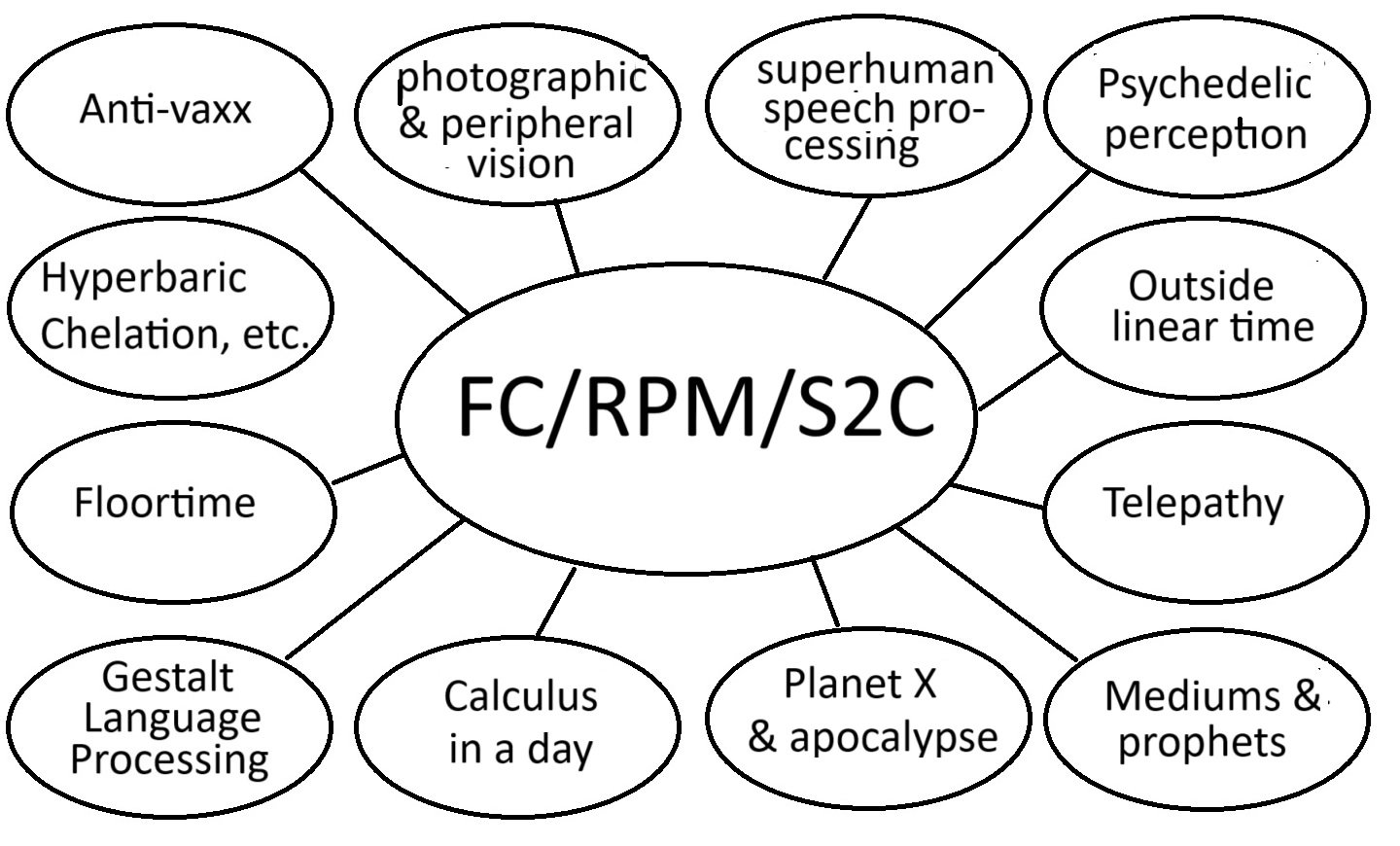
RFK Jr. and FC-Adjacent Beliefs: from chelation to Planet X to calculus in a day

With President-elect Trump’s announcement of Robert F. Kennedy Jr. as his nominee to run the Department of Health and Human Services and, in Trump’s words, “go wild on health,” we are faced with the prospect of someone playing a role in U.S. health policy who has said that a certain variant of FC should be celebrated “like the 4th of July.”

Though on leave since campaigning for president and then campaigning for Trump, RFK Jr. has long been the chairman of the Children’s Health Defense. One of the key policy positions of the Children’s Health Defense—and of RFK Jr. himself—is that vaccines cause autism. As a recent New York Times article reports, RFK Jr. also believes in fringe treatments like hyperbaric therapies and chelation. It also turns out that he believes in Spelling to Communicate, or S2C (more on that later).

RFK Jr. isn’t an autism parent, but his fringe positions are shared by a number of people who are. They include J. B. Handley, vice-chairman of the Children’s Health Defense and founder of Generation Rescue, another anti-vaxx organization that also promotes fringe treatments for autism. They also include Jenny McCarthy, current president of Generation Rescue, and Handley’s and McCarthy’s many followers in the autism parent community. Naturally, those who believe in one non-evidence-based notion about autism are prone to believe in others, and the belief that vaccines cause autism is frequently accompanied by the belief that megavitamins, restrictive diets, chelation, hyperbaric oxygen treatments, and/or fecal transplants can substantially alleviate autism symptoms, and that one or another variant of facilitated communication (FC/RPM/S2C or the Spellers Method) can unlock the communicative potentials of autistic individuals.

But parents (and other family members) who believe in FC/RPM/S2C are also committed to an additional set of beliefs: beliefs that are crucial to accounting for the language and content of the messages extracted from their children via FC/RPM/S2C. These include messages like this one, generated by a 12-year-old girl while being facilitated by her mother:

Doing fishlips to the audience is an expression of funny playfulness but can be misinterpreted as simple mindedness. (Zurcher-Long & Zurcher, 2014).

As another mother, reporting on her daughter’s FCed communications, tells us:

Emily was full of ideas and dreams, but the biggest one, the one she wrote about most frequently, was to visit London. We were astounded as she told us details of the city. She pictured Big Ben and the soldiers with enormous hats, she knew about the River Thames, and that tall red buses filled the streets. She was fascinated by Lady Di and knew all about her and her tragic death. We didn’t know where all this information had come from. We’d never told her anything about London. She told us she’d learned about it from watching the news; she’d been five at the time that Lady Di died. (Gilpeer & Grodin, 2021).

FCed messages, as these excerpts suggest, typically display sophisticated vocabulary and syntax, age-appropriate-to-advanced academic skills/knowledge, and remarkable awareness of current events, contemporary culture, and/or the pressing issues of the day. And yet FCed individuals, profoundly autistic as most of them are, typically don’t display sustained attention to spoken or written language. Nor, prior to being subjected to FC/RPM/S2C, do they receive much formal exposure to or instruction in grade-level academic content and skills: they are generally restricted to special education programs designed for profoundly autistic students. Therefore, those who believe (despite all the evidence to the contrary) that the FCed messages are being authored by the FCed individuals must also, necessarily, believe that these individuals have spent years sponging up tons of information—from history to politics to literature to physics— from sources other than teachers and academic settings, and in subtle ways that went unnoticed for years.

Then there are the practitioners. As with autism parents and family members, practitioners who profess to believe in one non-evidence-based autism treatment are prone to profess to believe in others—though it’s not always clear here that actual beliefs are in play. That is, while it’s reasonable to assume that parents truly believe in the efficacy of the treatments to which, often at great cost, they subject their children, it’s less clear what practitioners of non-evidence-based treatments actually believe—unless, perhaps, they are also autism parents/family members. Be that as it may, we often find FC practitioners expressing support for other non-evidence-based therapies, and peddlers of other non-evidence-based therapies expressing support for FC.

Of course, it’s not just the parents and the practitioners, but also many individuals in the broader community that surround the FCed individuals, who espouse these extraordinary beliefs in FC and FC-adjacent phenomena. RFK Jr. came by his FC-related beliefs by hanging out with J.B. Handley. Nor do parents, practitioners, and members of the broader community necessarily limit themselves to beliefs related directly to FC and other autism treatments. Once one starts believing in somewhat extraordinary things, those things can snowball into outrageously extraordinary things.

Let’s start with the somewhat extraordinary, and with the practitioners.

Besides the FC-adjacent, fringe “medical” beliefs of certain parents and associated quacks (anti-vaccine; pro-megavitamins, restrictive diets, chelation, hyperbaric oxygen treatments, and/or fecal transplants), there are the FC-adjacent, non-evidence-based therapies of certain practitioners. We’ve already posted about the overlapping beliefs of practitioners of the FC variant of Rapid Prompting Method (RPM) and practitioners of Floortime, another non-evidence-based autism therapy. Also recently expressing support for RPM is a cohort of speech-language pathologists (SLPs) we haven’t mentioned here before: practitioners of a non-evidence-based autism therapy grounded in a purported phenomenon called “Natural Language Acquisition”/”Gestalt Language Processing” (or NLA/GLP—see here and here for critical reviews). NLP/GLP-based therapy, originating with SLP Marge Blanc, has become so popular in the last decade, despite its complete lack of empirical support, that multiple sessions of the American Speech Language Hearing Association’s recent conventions have been devoted to talks by promoters, many filled to standing room only. Within the self-published book that set it all in motion, released back in 2012, we find Blanc depicting RPM as a way for autistic individuals who speak in “gestalts” (echolalia), purportedly via their right brains, to produce more analytical or generative language, purportedly via their left brains:

At the age of eighteen, Will was introduced to RPM, and a year later on, he was composing his own stories by pointing to letters. Effectively bypassing his oral language conundrum, RPM offered Will direct access to his left-brain generative language in a way that was not reliable with oral speech.

Some of Blanc’s acolytes have also embraced RPM, as we see here.

The realm of somewhat extraordinary, FC-adjacent beliefs includes beliefs that parents are committed to holding in order to explain the sophisticated language and content of the messages extracted from their children via FC/RPM/S2C. Here are some of the sorts of claims made by parents, or seen in FCed messages or in news reports by credulous journalists.

1. Extraordinary, unfounded claims about peripheral vision. These claims, were they not totally unfounded (see here), could explain how many FCed individuals are able to type with their index fingers without looking at the letter displays, and how they may be paying attention even when they don’t appear to be looking. In reality, peripheral vision isn’t precise enough to allow one to identify letters, let alone to read words.

2. Extraordinary, unfounded claims about photographic memory. These claims, were they not totally unfounded (see here), could explain how FCed individuals are able to read books without looking at any of the pages for more than a fleeting moment.

3. Extraordinary, unfounded claims about such extraordinary hearing that one can identify words spoken outside of most people’s auditory range; and such extraordinary oral language processing abilities that one can make sense of multiple conversations at once. These claims, were they not totally unfounded, could help explain how FCed individuals, despite their minimal access to formal academic instruction, are able to soak up vast amounts of information on a broad range of subjects from the surrounding environment.

Here are some specific instances of these claims.

First, from a 2006 Time Magazine article about Hannah Chadwick, a woman supposedly unlocked through facilitated communication:

During the silent years, it seems, Hannah was soaking up vast storehouses of information. The girl without language had an extensive vocabulary, a sense of humor and some unusual gifts. One day, when Jacob presented her with a page of 30 or so math problems, Hannah took one look, then typed all 30 answers. Stunned, Jacob asked, “Do you have a photographic memory?” Hannah typed “Yes.”

Like many people with autism, Hannah is so acutely sensitive to sound that she’ll catch every word of a conversation occurring elsewhere in the house, which may account for much of her knowledge. She is also hypersensitive to visual input. Gazing directly at things is difficult, so she often relies on her almost preternatural peripheral vision.” (Time Magazine, May 7th, 2006).

Second, from Carly’s Voice, a 2012 memoir written by the father of an autistic girl with FC-generated excerpts he attributes to her:

We take in many sounds and conversations at once. (p. 322).

I listen to everything… If a TV is on and I am in another room, I still listen to it or if people are talking I like to hear what they are saying even if they are not talking to me. Like I say all the time, just because it does not look like I am paying attention does not mean that’s the case. (p. 343).

I have a photographic memory that allows me to look at an image or a page of a book and memorize it in seconds. (p. 383)

Third, from a 2020, FC-generated post on Autism Prophets and attributed to Darcy Reed, “a proud, non-speaking autistic woman who has been typing to communicate since she was a small child”:

In the long run, perhaps people will understand that those of us on the spectrum have more neurons than neurotypicals. That makes us receive information at a rapid rate. That’s why you frequently bore us. You talk so slow it’s hard to focus for that long with so many other things going on. It is a good thing for absorbing information. I wasn’t taught anything in school, but thanks to documentaries and a family of intellectuals, I am quite well educated.

In other anecdotes, minimal speakers with autism are said to have learned Spanish by overhearing their siblings practice Spanish homework; physics by overhearing the proceedings of a physics class through the cafeteria wall; and current events by listening to NPR. They are said to be extraordinarily attentive, despite appearances to the contrary: able to see what they don’t appear to be looking at and hear what we might assume is too muddled or out of earshot. They are said to be sponges for knowledge and to have extraordinary capacities for long-term retention.

These extraordinary beliefs about the preternatural cognitive capacities of minimally speaking individuals with autism naturally lead some parents and their surrounding communities into beliefs about capacities that are full-on paranormal. Telepathy is the most obvious one. It lets FC believers invoke some reason other than facilitator cueing for why FCed individuals sometimes type out knowledge known only to the facilitators—as has happened during message-passing tests in the rigorous studies that have uniformly invalidated FC.
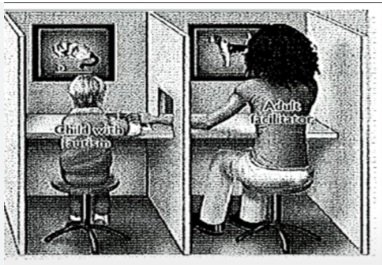
Depiction of a message-passing test. The facilitator is blinded to what the facilitated person is typing.

In an earlier post, Janyce discusses claims of telepathy that appear in a 40-page, self-published, 1993 booklet by pop psychology author Paul Haskew and University of Wisconsin education school professor Anne Donnellan (Emotional Maturity and Well-Being: Psychological Lessons of Facilitated Communication). Haskew and Donnellan

claim their subjects have a “sixth sense” that allows FCed individuals to communicate either through facilitation or, in some cases, without speaking or pointing to a letter board at all. Haskew and Donnellan include examples where nonspeaking individuals form “special education ghetto” gangs to cause trouble for their teachers and classmates—all done by telepathic communication that transcends physical boundaries. The students don’t even have to be in the same room to “communicate” with each other.

As a result, as Janyce reports, these individuals, per Haskew and Deonnellan, have:

difficulty separating their own thoughts from those of their facilitators. This, the authors assert, leads some nonspeaking individuals to take on the identities of their facilitators and, in some cases, develop identity disorders or characteristics of multiple personality disorder (now known as dissociative identity disorder.

As Haskew and Donellan explain it:

It may be that a sixth sense is present in all of us at birth, but as speech and locomotion develop, the need for it fades. Still, many people seem to retain vestigial psychic abilities, especially at times of accident or trauma, and there is much anecdotal scientific literature describing those. For people with impaired communication capabilities the sixth sense may remain active and utilized. The speaking world is simply rediscovering it. (Haskew and Donnellan 1993, p.9)

For additional claims by Donnellan about telepathy, see James Randi’s piece in Skeptical Inquirer.

More recently, self-described medium and facilitator Mary Ann Harrington has this to say in her website’s introduction:

All those interested in using these processes must be warned of possible purposeful or inadvertent influence by the thoughts of their communication partners. As a proponent and user for over thirty years, due to what feels like a merging of our consciousness, or simultaneous knowing, or an emergent voice; it is still difficult for me at times to tell where their thoughts from my own, especially if I am vested in anyway.

I choose to refer to those who use the process as Qautists since there appears to be a extra-senspry [sic] quantum component to the process. Many but not all Qautists have a diagnosis of severe autism. However, many autistic people, who display less significant language impairments do not share the Qautists’ abilities; at least not to the same extent. Other nonspeaking populations such as some diagnosed with down’s [sic] syndrome also share their gifts. Is it channelling? Is it mediumship? I don’t know. I do know they seem to have access to my neurology and know all that I know. They suggest they can tap into multiple realms of existence to get information. There seems to be no limit to their knowledge or ability to access it. It is me, as their communication partner that limits their responses; I am the one who causes destructive interference if I have not been exposed to the subject matter. For example, the spellers can speak any language; but their partner must understand the language for them to bring it through.

Since I define the role of a facilitator or communication partner differently, I will refer to those people who assist the spellers with communication as Catalysts. The purpose, responsibility, and development of the Catalyst needs study. The Qautists are already there just waiting for us to catch up. It begins with determining, what is and what is not part of the process.

Harrington also proposes that the reason why “Qautists do not need to look at the keyboard, but Catalysts do” may be that “Qautists adhere to the Catalyst’s sensory system-see-through their eyes, hear through their ears…” and that “the Catalyst and Qautist [may be] entangled as one emergent field of awareness…”

Darcy Reed (see above) adds:

There is also a special area where the truth detectors in my intuition can tell what is true and can often read minds.

In addition, the first episode of a podcast called The Telepathy Tapes discusses facilitated non-speaking autistic individuals who are able to read their facilitators’ minds. It doesn’t seem to occur to anyone on the show, including a self-proclaimed autism specialist by the name of Diane Hennacy Powell, MD, that the most likely explanation for this is facilitator cueing, not telepathy.

For another source sympathetic both to FC and to telepathy, see Olga Bogdashina’s 2011 book Autism and the Edges of the Known World: Sensitivities, Language and Constructed Reality (Jessica Kingsley Publishers).

Besides telepathy, beliefs about the extraordinary sensory skills of FCed individuals naturally lead some to ascribe exotic sensory processing to individuals with autism: especially synesthesia, which I’ve written about here and which is also reported on The Telepathy Tapes. Extreme synesthesia, of course, can be downright psychedelic, and a 2013 Los Angeles Times profile of a non-speaking boy subjected to RPM (Ido Kedar) contains this line: “Autism, Ido says, is like being on LSD.” Then there is unusual time perception: the ability not just to hear far away noises, but to see into the distant past. Here are some testimonials from Higashida, the FCed autistic boy credited with authoring the 2013 memoir The Reason I Jump, a book that many people have said—and some have told me personally—has given them a much deeper understanding of autism:

For us, one second is infinitely long—yet twenty-four hours can hurtle by in a flash. (p. 63)

We who have autism, who are semi-detached from the flow of time…” (p. 67)

[W]e are a different kind of human, born with primeval senses. We are outside the normal flow of time.” (p. 71).

[W]e are more like travelers from a distant past (p. 111)

From here, Darcy Reed’s report that “I remember everything, even past lives” isn’t too much of a stretch.

Nor is this statement from Maryann Harrington about the people she calls “Qautists” or “Quatists”:

In my opinion. Qautists do not learn everything from their environment or through direct instruction as suggested by proponets [sic]. They come in with a vast array of knowledge or at least access to it through access to it. How do the Quatists receive information from the Catalysts’ knowledge base, spirits, aliens, the akashic records, the Divine, or universal field of thought? Or whatever name you choose for the intuitive realms? Is the doorway of the subconscious to the superconscious mind wide open?

Finally, I nearly forgot these recent tweets from a father who has been facilitating his non-speaking son for decades:
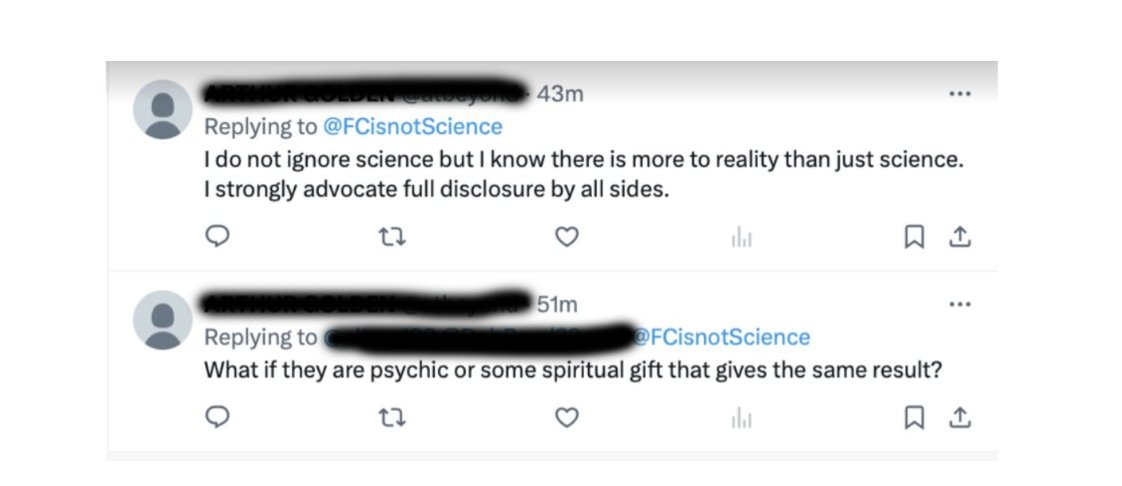
As we descend down the rabbit hole, additional magical entities appear. Darcy Reed reports seeing UFOs.  The LA Times profile of Ido Kedar informs us that:

Ido says he can also see auras, emanations of color around people that help him gauge their temperaments.

His mother is blue, his sister is green and his father is greenish-yellow. Purple, he says, is the most open-minded color, brown the most closed off.

Brown is the color of my ABA teachers.

Sharon Smith of the Sharonsweb Autism Foundation and the mother of two non-speaking, FC-ed children, sells tickets for events that showcase her children’s paranormal abilities:

Explore the extraordinary world of energy and communication beyond words with Noah and Adriana, two nonspeaking individuals with autism. They demonstrate their abilities in mediumship, telepathy, and energy reading during this interactive session with Sharon's assistance.

(Sharon’s assistance of Noah and Adriana is via old-school, touch-based FC.)

Noah and Adriana are credited with authoring two chapters (chapters 4 and 17, respectively) of a book entitled The Ancestors Within. Here, they are described as

autistic non-speakers with extraordinary abilities. They are powerlifters, authors, mediums, energy healers and the list keeps growing!  In 2016 they began using facilitated communication. In 2020 they demonstrated telepathy and made friendship connections building their tribe to support and enhance each other.

Here is an excerpt from Chapter 4:

Thoughts that come from someone else are your spirit guides. You are already in tune with your ancestors! This is the start of understanding what I do. You need to relax and listen to these voices or feelings. Trust your instincts. 

Moms of children with nonverbal autism may have a harder time with this because those children attract more spirits and energy than other children. It may appear chaotic and overwhelming. Your energy is often really overpowering to them, and you interrupt the natural flow that these children are used to hearing in their heads. Just know they hear you, and you don’t need to raise your voice. Understand they sense your frustration and your fear.

And here is an excerpt from Chapter 17:

I am Adriana. A manipulator of energy. A keeper of time. A watcher of the spirit realm. What your world would consider an adult with autism. What does that mean? I don’t know what it means to you, to me it means that I’m halfway in this universe and I’m halfway out of this universe.

Grandma Chandra, another non-speaker facilitated by her mother, has her own website, where we learn that:

[She] reads Auras from the Quantum Light Field, heals through the Light codes and frequencies within her Holographic Fractal videos. She works with Sacred Geometric forms, high vibrational essential oils, apps and her healing green laser that are all personally encoded for each client. Grandma is an Indigo Eiyanni who came to Gaia to help with Ascension through her products and readings. She is a multi-dimensional being who communicates with many people around the globe telepathically sometimes in Light language thru her videos and audios. Like the Whales and Dolphins she is clairvoyant, clairaudient and clairsentient. As the Whales are the Keepers of the Akashic Records, Grandma Chandra has full access to these Records.

For some parents and their surrounding communities, the paranormal is specifically religious—a connection to profound autism that dates at least as far back as the so-called “holy fools” (mostly of the 14th century): certain individuals with autistic traits recognized as saints by the Russian Orthodox Church (see Donvan and Zucker, 42). Some 6 centuries later, a particularly striking account of the autism-paranormal-religion trifecta is found in a 1997 article entitled “What does the soul say? Metaphysical uses of facilitated communication in the Jewish ultraorthodox community” (Bilu & Goodman, 1997). Bilu and Goodman write that starting in the early 1990s FC “was transformed in the Jewish ultraorthodox [Haredi] community into a mystical device through which autistic children disclose otherworldly messages” and that the children “were perceived as mediums susceptible to supernormal agencies.” Their feats include “fluent communication in foreign languages… communication during states of deep coma, absorbing written material and conducting complex calculations at enormous speeds, and knowledge of Divine Truth”, and “based on the experiences of their souls in the afterworld, [they] are cognitive of his [God’s] omnipresence and guidance.” According to one of the group’s publications:

all the brain-damaged know without exception that they had lived in this world before, know their former names and parents’ names, and know the sin for which they came into this world in such a miserable form.

Here is an excerpt of an interview cited by Bilu & Goodman of one of the facilitated non-speakers:

Q: Why did you come into the world in this form?

A: There is no suffering without sin, and I sinned in forsaking study of the Torah.

Q: Why have so many troubles been occurring recently?

A: Because of [the prevalence of] the “evil tongue” and sexual relations with menstruating women.”

Reading this, I wondered why no one has cited profanity and sexual relations during menses as one of the reasons for the dramatic rise in reported rates of autism that took off around this time.

Several decades on, the non-speaking, FCed prophets in this community are still active, as we learn from a 2016 article in Israel 365 News entitled “The Planet Nibiru and the Apocalypse.” This article focuses on the FCed prophets’ prophecies about a purported planet alternately known as Nibiru or as Planet X. According to scientist and author Zechariah Sitchin, this purported planet comes from beyond Pluto and passes through our solar system every 3,600 years. The article—written in 2016—reports that about 50 years ago (circa 1966), Sitchin decided that in about 50 years (i.e., 2016), Nibiru would come close enough to earth to cause “extensive damage to Earth’s land masses and death to millions.” Sitchin died in 2010, but in late December 2015, according to the article, three non-speaking prophets, Menachem, Daniel, and Binyamin, described via FC-generated messages “a picture of apocalyptic devastation from which only the Land of Israel remains unscathed.”

In his recorded FC session (December 23, 2015), Menachem suggested that “world leaders are preparing for the inevitable doomsday collision by preparing elaborate bunkers” and that, in words generated by FC, “the people who are outside, those who have trust in Hashem (God) – they’ll be saved.”

In his recorded FC session (December 27, 2015), Daniel prophesized that (via FC-generated words):

The effects of ‘Nibiru’ will be giant tsunamis with waves 100 meters high, earthquakes, tornadoes, erupting volcanoes, there will be a hit to nuclear reactors that will cause radioactive contamination like in Fukushima, Japan. And there won’t be electricity, and there won’t be clean water, and there won’t be food – it will be a very difficult situation. We in Eretz Yisrael will be like in Noah’s ark.

Finally, in his recorded FC session (December 30, 2015), Binyamin prophesized that (via FC-generated words):

“And I say to you: there’s going to be a huge disaster. A huge disaster, really.  Hashem (God) – He’s the only one Who can destroy the world that He Himself created. It will be a huge disaster, and this disaster will destroy two-thirds of the world. And it will leave Eretz-Yisrael (Land of Israel) complete… Now you want to know how it will happen… I don’t know exactly, but from all the possibilities I’ve heard, the matter of the star – it seems to me the most real.”

The article assures us that claims about Nibiru’s existence and destructive forces have been “repeatedly debunked, as recently as February 2014March, 2014 and July 2015.”

Pastor Paul Begley, host of the TV show The Coming Apocalypse and owner of a YouTube channel with more than 240 million subscribers, reports on Menachem’s, Daniel’s, and Binyamin’s FCed prophecies in a video posted 8 years ago—but he, unlike Israel 365 News, does so with utter credulity.

Of course, the world always seems to be about to end, which takes us back (or forward) to the incoming administration and Robert F. Kennedy Jr. While RFK Jr. holds several FC-adjacent beliefs—i.e., in the efficacy of hyperbaric therapies and chelation and in vaccines causing autism—and is a close associate of J.B. Handley, who holds both FC-adjacent and pro-FC beliefs, how do we know that Handley’s FC beliefs have infected RFK Jr.? We know it from a 2021 episode on the RJK Jr. podcast, itself recorded shortly after the publication of JB Handley’s S2C miracle cure book, Underestimated. Here’s what RFK Jr. had to say about Handley and his S2Ced son:

For the first 18 years of his life he [Handley] believed his son was mentally retarded… and at one point he called me and explained this new process that had just been created by these incredibly intuitive teachers who developed this ability to communicate with people who are non-speakers on… whiteboards [sic] and what he told me then which is one of the stories told in the book is this extraordinary discovery that these children have absolutely exquisitely functioning minds and that their difficulty is motor coordination, particularly in small skills. So they aren’t able to communicate not because they're not having very sophisticated and profound thoughts… but because they can't force their tongue which has all these nerves and muscles in it to actually articulate that and their bodies are completely out of their control… The book describes this incredible discovery of a loving father, devoted father that the son he’s known for all these years is actually a complete person… who is probably smarter than any of us. He learned to do calculus in essentially a day. And his calculus teacher said I can’t teach him anymore. We need a college level teacher because he’s too fast.

It’s a later point in the same podcast when RFK Jr. tells us that S2C should be celebrated “like the 4th of July.”

Not only has RFK Jr. swallowed hook, line, and sinker the FC-proponents’ non-evidence-based overturning of the longstanding diagnostic criteria autism—and of eight decades of autism research—and their magically transforming of autism from a socio-cognitive disorder into a motor disorder; he has also so thoroughly bought into the claims by FC-proponents that FC (S2C in particular) unlocks preternatural brilliance that he thinks it’s possible for an FCed person to learn calculus in a day.

For those who either avoided calculus or don’t remember what it involved, Wikipedia provides a list of topics covered. Here’s the first question on a sample AP calculus exam:
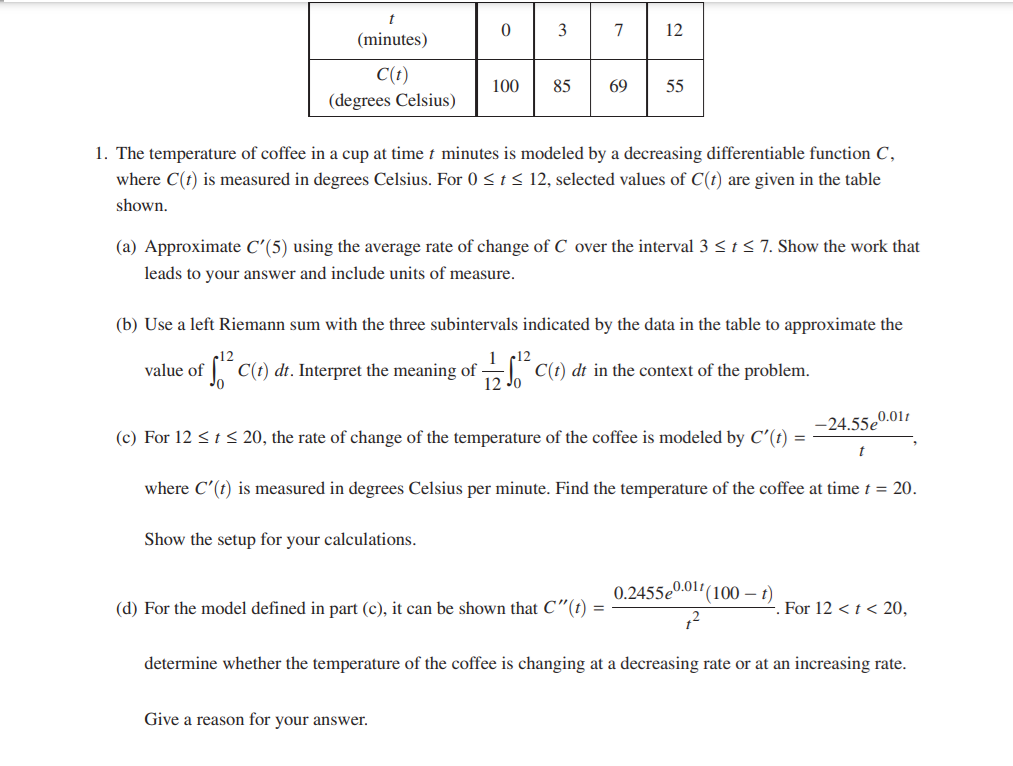
Not even Newton and Leibnitz, the two inventors of calculus, learned calculus in a day. Neither did Einstein. A gigantic number of people are scientifically illiterate and believe in non-evidence-based and supernatural phenomena; hardly anyone thinks anyone can learn calculus in a day.

What all this means is that a future advisor on America’s healthcare, in addition to believing that S2C should be celebrated like the 4th of July, holds one of the most extraordinary of all of the many FC-adjacent beliefs.

References

Bilu, Y., & Goodman, Y. C. (1997). What does the soul say? Metaphysical uses of facilitated communication in the Jewish ultraorthodox community. Ethos, 25(4), 375–407.

Blanc M. (2012). Natural language acquisition on the autism spectrum: The journey from echolalia to self-generated language. Madison, WI: Communication Development Center.

Donvan John & Zucker, Caren, 2016. In a Different Key: The Story of Autism. Crown.

Fleischmann, A. (2012). Carly’s voice: Breaking through autism. Touchstone (Nashville, Tenn.).

Gilpeer, V., & Grodin, E. (2021). I have been buried under years of dust: A memoir of autism and hope. William Morrow.

Handley, J. B., & Handley, J. (2021). Underestimated: An autism miracle. Skyhorse.

Higashida, N. (2013). The reason I jump: One boy’s voice from the silence of autism. Hodder Stoughton.

Zurcher-Long, E., & Zurcher, A. (2014, July 4). Emma Zurcher-Long & Ariane Zurcher Present - My Body Does Not Obey My Mind [Video]. YouTube https://www.youtube.com/watch?v=8xDuIlRrtb8

See also:

https://www.facilitatedcommunication.org/blog/a-magician-cannot-dispute-fc-or-can-he

https://www.facilitatedcommunication.org/blog/do-fced-individuals-have-telepathic-superpowers?fbclid=IwY2xjawGa8rRleHRuA2FlbQIxMAABHbzhQjXouiNI4K41pLJC9j18c0R9PcICgFTjerecYuTIF7TYFqajBEy6aA_aem_b1zPL5y2xp-9JfvoJgqKPQ

https://www.facilitatedcommunication.org/blog/another-side-effect-of-fc-alternative-facts

https://www.facilitatedcommunication.org/blog/peripheral-vision-perfect-for-detecting-facilitator-cues

Tuesday, December 10, 2024

My single most controversial slide at ASHA

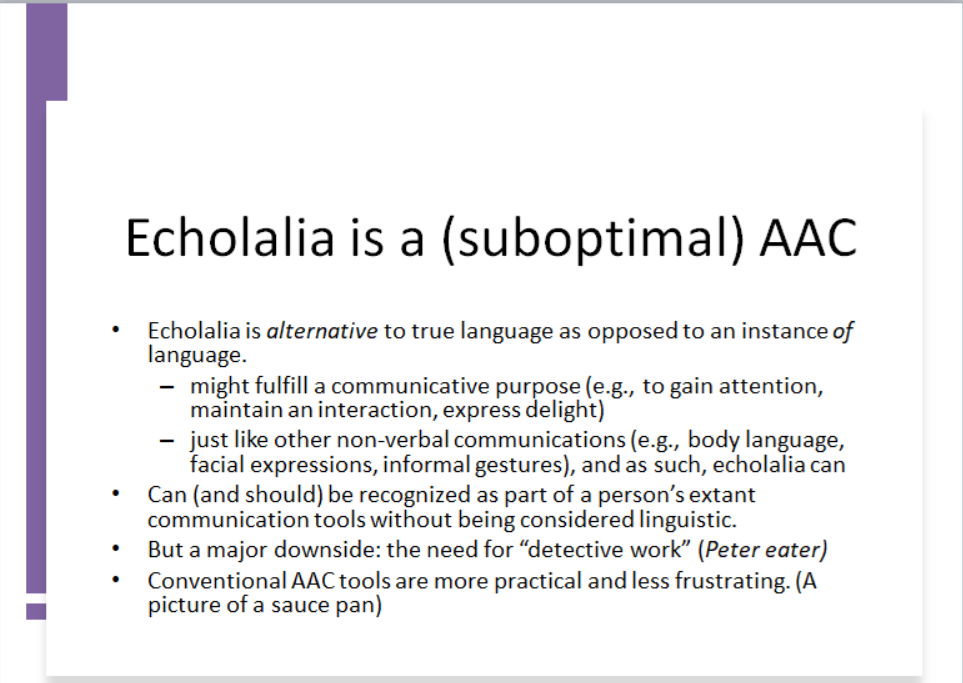
Seen by thousands of people in multiple overflow rooms at the Seattle Convention Center, reposted all over social media, and disparaged by some hard-core promoters of Gestalt Language Processing (GLP) as "ableist" and anti-neuro-affirming:


And yet not one person who has objected to this slide has provided any reason why this slide is objectionable that relates to what it actually says.

Increasingly, the echolalia-affirming space of GLP promoters strikes me as one gigantic... echo chamber.

Monday, November 18, 2024

In which Vikram Jaswal fails to establish the authenticity of S2C for non-speakers

 Cross-posted at facilitatedcommunication.org.

In a recent episode of Barry Prizant’s Uniquely Human podcast entitled “Establishing the Authenticity of Supported Communication for Non-Speakers,” Vikram Jaswal, a psychology professor at the University of Virginia, attempts to make a case for the variant of facilitated communication (FC) known as S2C.

This is Jaswal’s first appearance on Prizant’s podcast, and the episode centers on an eye-tracking study that he co-authored four years ago (Jaswal, 2020) that purportedly shows evidence for S2C. The most interesting parts of the podcast, however, are the parts where Jaswal discusses IQ levels in non-speaking autism, facilitator influence, communicative independence, and what Jaswal (and Prizant) have to say about his critics, AKA “the naysayers.” The podcast also features a co-host, David Finch (“Dave”), who was diagnosed with Asperger’s syndrome by his wife.

Jaswal begins by recapping his experience with autism, characterizing himself as “new to autism” even as recently as 2015, when he was invited to talk about autism research at a summer institute—despite the fact that “I didn’t… know much about autism at the time.” The person who extended this rather surprising invitation was Elizabeth Vosseller, the founder of the summer institute and the “inventor” of S2C (or, more precisely, the person who, after being trained in another variant of FC known as the Rapid Prompting Method or RPM, rebranded that method as Spelling to Communicate or S2C). The summer institute was for “nine or ten non-speaking autistic young adults all of whom at the time were communicating by pointing to letters on a letterboard held vertically by a trained communication and regulation partner”—the hallmark of S2C. For Jaswal, witnessing this variant of FC was “a transformative experience,” and “To say that I was blown away is an understatement”. He adds:

It’s changed my life, it’s changed my research program, it’s changed how I think about the world, and about psychology and communication.

What Jaswal leaves out here (and pretty much everywhere else, including in the disclosure statement in his eye-tracking study) is that he has a non-speaking autistic daughter who uses S2C. According to a piece in the Washington Post written by Jaswal and his wife, his daughter was in second grade in 2016. This means that Jaswal was, in 2015, neither “new to autism” nor an unbiased observer

Indeed, by the time he attended Vosseller’s summer institute, as he makes clear on the podcast, Jaswal was already convinced that much of the longstanding research on autism was wrong. In particular, he was (and is) convinced that there is no Theory of Mind impairment in autism and that there is no cognitive impairment in non-speaking autism. Further strengthening these convictions were the messages he saw being extracted from the non-speaking attendees of Vosseller’s summer institute via S2C, and, perhaps, some additional interactions with other autistic people over the years:

Over and over again as I’ve gotten to know autistic people, of course they understand other people’s beliefs goals desires and they recognize that behaviors are motivated by underlying intentions.

To the extent that Jaswal’s (informal and subjective) impressions are based on messages extracted from non-speaking individuals via S2C, all the available evidence indicates that the people demonstrating these Theory of Mind skills are actually the non-autistic facilitators, or what S2C proponents call the “communication and regulations partners” (CRPs). Without a message-passing test that would establish who is authoring these messages, we can’t know.

As for the Theory of Mind research, Jaswal states that the experiments “were designed in a particular way that was not suitable to allow autistic folks to demonstrate their underlying” skills: claims that he has elaborated in a 2018 article which has been critiqued here and in an earlier post on this blog.

As far as the research showing low IQ in non-speaking or minimally-speaking autism goes (see Anderson et al., 2007; Wittke et al., 2017; Wodka et al, 2013), Jaswal has not published any critiques. Instead, he simply asks “How can somebody who doesn’t have a way to express themselves using language-based communication participate in a lot of standard IQ tests?” He has apparently forgotten that, in the standard IQ tests used with children, only the verbal IQ subsections of those tests require verbal communication. Indeed, that’s why studies of IQ in non-speaking children tend to focus only on nonverbal IQ, aka Performance IQ. The studies listed above are no exception, and they find that nonverbal IQ is significantly impaired in non-speaking autism.

Jaswal, however, cites a Canadian study that, he claims, challenges these results: a study by a “really progressive group of Canadian autism scientists” that used a “strengths-based approach” to investigate IQ in “a group of elementary school-aged non-speaking kids.”  Jaswal notes that their assessments required neither verbal responses, nor motor responses “that are different from those that they would otherwise use in their daily lives.” The study Jaswal is most likely referring to—the only one that fits this description—is Courchesne et al, 2015. The study he’s referring to, Jaswal claims, finds that most of these kids “actually scored within the normal range on the strengths-based IQ tests.”

The IQ test that Courchesne et al. used was a version of the Raven’s Progressive Matrices test: a test that places minimal verbal demands on those being tested, even for comprehending the test directions (which, importantly, can be an issue even with test questions that don’t require verbal responses). For that very reason, the Raven’s Progressive Matrices test is, in fact, a common way to assess IQ in autistic individuals with language impairments.

Seemingly consistent with Jaswal’s statement that the study’s IQ test didn’t require motor responses other than those that the children could perform in their daily lives, the version of the test that the researchers used, the Raven’s Colored Progressive Matrices (RCPM), doesn’t require pointing: something that many of the minimally-speaking autistic participants were unable to do. But, while there is evidence for a lack of (or reduced) pointing in autism, there isn’t evidence, as I’ve discussed in other posts, that lack of pointing in autism is due to motor issues. Proponents of S2C, of course, insist otherwise: for them, “unreliable pointing” results from fine motor difficulties that, in turn, justify the need for held-up letterboards. Pointing, however, isn’t just a motor activity; it’s also a communicative gesture, and reduced communicative gesturing is a hallmark of autism (Manwaring et al., 2018). Furthermore, in lieu of pointing, the RCPM test requires a different fine motor skill: placing one of “six movable pieces” into the empty space that represents the missing part of a multi-dimensional pattern.

What about the study’s results? Contrary to Jaswal’s claim that most of the non-speakers scored within the normal range, the researchers found that:

  • Of the 26 (out of 30) minimally-speaking autistic participants who completed the test, there was an average raw score of 18.61 out of 36.

  • Their non-autistic counterparts had an average raw score of 28.5 out of 36.

  • While eight of the autistic participants performed at or above the 50th percentile, with three at the 90th percentile, “autistic children's RCPM performance differed according to their reported spoken language level” with “autistic children using two-word phrases performed better… than those using no words at all.”

So much for Jaswal’s claim that a Canadian study using a strength-based assessment on non-speaking autistic elementary school students shows that most non-speakers scored within the normal range.

Moving on from Theory of Mind and IQ, Jaswal and Prizant rehash some of the other pro-S2C, evidence-free talking points:

  • That individuals with autism have trouble controlling their bodies (see the sensory-motor section of our misleading articles page).

  • That the big challenge in autism isn’t helping individuals improve actual communication skills, but giving them access to effective ways to communicate (as if all there’s no evidence of widespread communication challenges in autism, and as if there’s any evidence that responsible professionals are systematically depriving autistic people of effective ways to communicate).

  • That it’s the people outside the world of S2C, not S2C proponents, who suppress and ignore the communicative gestures made by non-speaking individuals (see Beals, 2023).

The discussion then turns to the facilitator, or “communication and regulations partner” (CRP). Citing the messages facilitated out of S2C-ed individuals by their CRPs as testimonials, Jaswal claims that the purpose of the CRP is for “attentional, regulatory, emotional support.” He suggests that the S2Ced individuals’ emotional needs may stem, not just from co-occurring conditions like anxiety, but also from the “trauma” of having been long denied an effective means of communication. As for the possibility that CRPs might be the ones depriving autistic individuals of effective communication by controlling the messages, Jaswal minimizes this in several ways.

First, he claims that influence is “just part of the way communication works”. He cites Prizant’s affirmative head nods and states that these “giv[e] me the confidence to continue”—as if nodding while someone speaks is comparable to the influence that facilitators exert on message content. While acknowledging the concerns of FC critics about CRP influence on messages, he resolves this concern by (1) saying that this is something the non-speakers are “absolutely aware of,” and (2) changing the topic to how hurtful these concerns must be to non-speakers:

Imagine now that you’ve worked really hard on the skills to be able to communicate by pointing to letters with the assistance of a CRP and, and now you learn that there are people who don’t believe what you’re saying, that there are people who want to deny you access that method and related methods of communication. That’s only going to contribute further to somebody’s trauma.

At this point the conversation turns to Jaswal’s 2020 eye-tracking study (critiques of which are here and here), and Jaswal proceeds to repeat his mischaracterization of the ways FC critics say that facilitators can cue (and control) letter selection. That is, Jaswal depicts this cueing not as the automatic, non-conscious phenomenon that studies of FC and related phenomena have unearthed (see, e.g., Spitz, 1997) but as something that involves conscious interpretation and deliberate decision-making and would take more time than what he characterizes as the “fast clip” (he also calls it “very fast” typing) at which many of the participants selected letters. (Their actual speed was, on average, and as Jaswal confirms here, one letter per second, which most people outside of the Spellerverse would consider quite slow, even for single-finger typing[1]). With Prizant and Dave laughing along and perhaps also head nodding in agreement, Jaswal states:

There is some reason to think that there are limits on the human information processing ability to make use of cues from the environment in order to drive our behavior, so one example is like, you know, I don’t know about you, but like if you’re at a restaurant with your family and, uh, you know, one member of your family wants you to notice person’s shoes at the table next to you they might make a subtle cue—nod their head in a particular direction or roll their eyes over there and you have to notice the cue, interpret its meaning and then like decide how am I going to act based on that cue. So these things—this detection of the cue, this… noticing that it occurred, this… figuring out what it means, and then this action program after having understood it—like, those things take time. So each of those steps takes time. And so as I have spent time with non-speaking autistic people who spell, many of whom spell so quickly and so accurately that I think it’s just… beyond belief that they’re simply responding to cues that many of the rest of us wouldn’t be able to notice sitting next to them that the CRP or communication and regulations partner is offering.

It doesn’t seem to occur to Jaswal that some of the cues that critics are talking about require no interpretation or deliberation. These include:

  • The CRP shifting the board so that the person’s outstretched index finger approaches a particular letter.

  • The CRP moving their free hand in a movement that mirrors the movement that would be involved in a particular letter selection, doing so milliseconds before the S2Ced person makes that movement and that letter selection (see here for examples and discussion).

These cues are less like the deliberate, consciously interpreted restaurant cues Jaswal imagines, and more like the tactile pressure cues that immediately tell horses exactly where to turn and how fast to go, or the vestibular and proprioceptive cues that immediately tell cyclists exactly how to maintain their balance. These phenomena occur in well under a second, are largely non-conscious, and yet completely control a horse’s or a person’s movements.

Nor does it seem to occur to Jaswal that these sorts of cues are qualitatively different from the facial and social cues that many studies show autistic people to be under-sensitive to. On one hand, Jaswal dismisses these findings as purportedly as problematic as the Theory of Mind findings. On the other hand, he brings them up in connection with CRP cueing, claiming that, to the extent that FC critics believe these findings (we do), they would contradict our claims about CRP cueing (they don’t).

Jaswal also repeats another of his study’s key misconceptions: that since intentional acts involve looking, acts that involve looking are intentional. This is what allows him to conclude that, since the participants were, on average, looking ahead at the next letter a half-second before they typed it, they must have been intentionally pointing to that letter, and that it therefore couldn’t be the case that the CRP was moving the board. But looking ahead neither logically entails intentionality nor logically rules out board movements, nor does any of this rule out the possibility that the participants’ eyes were responding to the same cues that their fingers were—and/or were simply looking at whichever letter the CRP (however unintentionally) moved into their line of sight.

Prizant, Barry, and Dave then move on to the “naysayers.” Jaswal claims that they/we haven’t come up with any alternative explanations for his data, apparently unaware of the published critiques that do just that (Beals, 2021; Vyse, 2021). Dave, who calls himself an engineer but whom Prizant calls a “scientist,” proceeds to emphasize the importance of data. Prizant, confusing skepticism with non-evidence-based beliefs and lived experience with evidence [2], claims that it’s the naysayers who are the ones who are making assumptions and Jaswal who is being conservative with respect to the alleged evidence.

The conversation then turns to the CRP—with Jaswal citing research on how, in stressful situations, the physical presence of people we’re close to helps to keep us regulated. Connecting this to non-speakers, he notes how anxiety-provoking it must be when a school suddenly swaps out a child’s aide with a new aide. Jaswal doesn’t extend this to CRPs, but Dave does, and presumably Jaswal would agree that it’s also potentially anxiety-provoking when parent suddenly swaps out one CRP for another. Dave, for his part, compares the CRP to the “buddy” that company executives apparently always bring with them to meetings:

I can’t think of a single executive who rolls into a very high-level meeting without his little buddy there, whether it’s the attorney or the regional salesperson who’s there as a safety person to make sure that person’s message gets across. And  we don’t challenge that.

Finally, the conversation turns to the possibility of AI taking over some of the CRP’s roles, and Jaswal expresses certainty that, while some of the CRP’s roles might be automated and offloaded to AI, he thinks that there will always be a CRP present. And, of course, as long as a CRP is present, the likelihood persists that the S2C-ed messages are not the authentic communications of the S2Ced individual—even if the actual author is now some combination of the CRP and the AI.

Nonetheless, Jaswal is confident, not only that there is no significant influence by CRPs on messages, but also that some of the S2Ced individuals now type independently. But he also makes it clear that those “independent typers” do not actually type independently of their CRPs:

Among those who type independently they still benefit from the presence of another person who can serve as that… regulation partner and who is able to redirect them when their ADHD leads them astray, for example, or when their OCD leads them to focus on something that person who can help them get back on track.

Apparently, even when S2Ced individuals recover from their alleged fine motor control issues, dyspraxias, and mind-body disconnects, there’s still a lingering (diagnosed or undiagnosed?) ADHD or OCD…or?—anything to justify the continued presence, and influence, of the CRP.

Prizant and Jaswal conclude the podcast with a celebration of interdependence:

  • Prizant: “Self-determination comes with support… You need that trusting person around you, that safety net, to take risks and get out there.”

  • Jaswal: “We are interdependent… We are all relying on each other. Why should it be any different for a non-speaking autistic person?”

Dave adds that we depend on each other to help us see our blind spots, whereupon Prizant concludes the podcast with an allusion to “the elephant in the room”: presuming competence.

Presuming competence—that ill-advised but persistent mantra of FC/RPM/S2C proponents used to deter people from asking who is directing the messages and to justify their refusal to participate in rigorous tests that could answer this question. Fittingly juxtaposed, here, with blind spots.

NOTES

1. Perhaps in an attempt to explain away the slowness of the typing, Prizant compares it to typing in the confirmation code or frequent flyer code into an airport scanner: “You’re scanning the screen and visually searching out the next number in the code.” To this, Jaswal replies: “That’s a really good analogy.” But of course, typing out your actual thoughts using the familiar letter sequences of conventional spellings is quite different from typing in the arbitrary sequences in a confirmation code.

2. Prizant cites, as evidence, “Talking to dozens of families and parents and people who are spellers and typers which has been totally dismissed as any aspect of evidence here by the naysayers.”

REFERENCES

Anderson, D. K., Lord, C., Risi, S., DiLavore, P. S., Shulman, C., Thurm, A., et al. (2007). Patterns of growth in verbal abilities among children with autism spectrum disorder. J. Consult. Clin. Psychol. 75, 594–604. doi: 10.1037/0022- doi:10.1080/17489539.2 021.1918890 006X.75.4.594

Beals, K. (2021). A recent eye-tracking study fails to reveal agency in assisted autistic communication. Evidence-Based Communication Assessment and Intervention, 15(1), 46–51.

Beals, K. P. (2023). Sit down, shut up. Index on Censorship52(2), 60-61. https://doi.org/10.1177/03064220231183821

Courchesne, V., Meilleur, A. A., Poulin-Lord, M. P., Dawson, M., & Soulières, I. (2015). Autistic children at risk of being underestimated: school-based pilot study of a strength-informed assessment. Molecular autism6, 12. https://doi.org/10.1186/s13229-015-0006-3

Jaswal, V. K., Wayne, A., & Golino, H. (2020). Eye-tracking reveals agency in assisted autistic communication. Scientific Reports, 10(1), 7882. doi:10.103841598-020-64553-9 PMID:32398782

Manwaring, S. S., Stevens, A. L., Mowdood, A., & Lackey, M. (2018). A scoping review of deictic gesture use in toddlers with or at-risk for autism spectrum disorder. Autism & Developmental Language Impairments3https://doi.org/10.1177/2396941517751891

Spitz, H. (1997). Nonconscious Movements: From Mystical Messages To Facilitated Communication. Routledge.

Vyse, Stuart. (2020, May 20). Of Eye Movements and Autism: The Latest Chapter in A Continuing Controversy. Skeptical Inquirer.

Wittke, K., Mastergeorge, A. M., Ozonoff, S., Rogers, S. J., & Naigles, L. R. (2017). Grammatical language impairment in autism spectrum disorder: Exploring language phenotypes beyond Standardized Testing. Frontiers in Psychology, 8, 532. doi:10.3389/fpsyg.2017.00532 PMID:28458643

Wodka, E. L., Mathy, P., and Kalb, L. (2013). Predictors of phrase and fluent speech in children with autism and severe language delay. Pediatrics 131, 1–7. doi: 10.1542/peds.2012-2221

Friday, November 8, 2024

Actually this is mostly about you—and (indirectly) about FC

 (Cross-posted at FacilitatedCommunication.org)

The 2021 biopic This is Not About Me, recently became available for a small rental fee on YouTube. Given its topic (more on that below) and financial backers (the pro-FC organization CommunicationFirst and several other pro-FC organizations and individuals), I felt I had to see it.

This is Not About Me aspires to send a broad message on behalf of all non-speakers. Teachers and therapists need to recognize that disruptive and aggressive behaviors are often the result of emotional distress and frustration--including the frustration of not having adequate means to communicate one’s wants, needs, and emotional distress. Instead of suppressing such behaviors through restraint, or corralling and punishing them through seclusion, teachers and therapists should view them as cries for help. Everyone who works with the child must figure out what the child is communicating, make changes to address the child’s needs and distress and, so that the child can express those needs more clearly going forward, help the child access the tools she needs to fully express herself. These tools may also reveal that the child is much more capable than teachers and therapists have assumed: capable, perhaps, of more than just life skills classes, simple object labeling, repetitive directions-following; capable, perhaps, of accessing the general education curriculum.

These messages are eminently wise, reasonable, and ethical. They’re also messages that properly trained teachers and therapists have been exposed to for decades—and that decent, self-controlled teachers and therapists routinely act upon (Heward and Orlansky, 1988).

What’s new, as recounted in This is Not About Me, are two completely different items. Item one is the challenges of its subject and the horrendous treatments she experienced at the hands of teachers and therapists who either were somehow ignorant of, or willfully ignored, the above messages. Item two is a set of curious omissions and suggestions which, taken together, might appear to lend some credibility to facilitated communication—at least in the eyes of those who are already prone to believe in one or more variants of it (FC, Rapid Prompting Method/RPM, and/or Spelling to Communicate/S2C).

In other words, This is Not About Me is more about its subject and her peculiar circumstances than about most other special education students and their experiences, and its messages—those, that is, that aren’t already part of the common, longstanding wisdom and professional ethics in the world of special education professionals—have more to do with the plausibility of FC/RPM/S2C as valid communication methods than with how schools should treat special education students.

The subject of the documentary, a now 29-year-old woman by the name of Jordyn Zimmerman, is repeatedly described as non-speaking, including on the This is Not About Me website. Zimmerman’s own website states that “After being diagnosed as autistic at a young age, she did not receive access to augmentative communication until the age of 18.” Zimmerman is Board Chair of the pro-FC organization CommunicationFIRST and serves on The United States President's Committee for People with Intellectual Disabilities. In addition, she is an Apple Distinguished Fellow and a guest blogger at AssistiveWare (AssistiveWare being another of This is Not About Me’s financial backers, and the creator of the software that Zimmerman uses on her Apple iPad as her augmentative communication tool). According to Zimmerman’s website, she is now pursuing an MBA at the online school Quantic School of Business and Technology.

This is Not About Me is bookended by two statements about how unusual Zimmerman is. One of its first sound bites is “She was probably one of the most challenging children I’ve ever worked with.” The speaker, autism program director Wendy Bergant, describes Zimmerman’s extreme reactions to unexpected change and how she would hurt herself in “ways that were very uncommon to see even in my field.” One of the last sound bites, from attorney Virginia Wilson, is “I think she is unusual but I think the things she’s done all kids that are nonverbal can benefit from.”

Even those who aren’t particularly familiar with autism spectrum disorders know that challenging behaviors are common in autism. For those who are familiar with autism, what should appear especially unusual about Zimmerman is her linguistic profile, as portrayed by This is Not About Me. While we never hear Zimmerman speak, we do see her type on her AssistiveWare-enabled iPad. And while many non-to-minimal speakers with autism can type basic words and routine phrases independently, Zimmerman can type sophisticated words and novel sentences: sentences like “I have a challenge for all of you,” “Tell students to go after their dreams,” and “Do you accept my challenge?” Furthermore, while nearly all FCed individuals appear to type sophisticated words and novel sentences, but only when a “communication and regulations partner” (CRP) hovers within auditory, visual, and tactile cueing range and stares at the letterboard or keyboard, Zimmerman’s typing is clearly independent. Not only is there no CRP hovering over her; she types much faster than FCed individuals and uses both hands—which makes letter cueing much more difficult than it is in the case of the single, wandering index finger that typifies facilitated typing.

But I’m guessing that most people won’t fully appreciate the significance of these differences between Zimmerman’s typing and the typing of someone who is subjected to FC—especially if that person’s CRP is merely sitting next to them and not touching them or holding up the letterboard. That’s because I’ve heard two of the autism language experts at last year’s NIDCD Webinar equate Zimmerman’s communication skills with that of an FCed individual who falls into the latter category.

This confusion has detrimental consequences. The more Zimmerman’s clearly independent typing is confused and conflated with too-subtle-for-naïve-eyes FC, the more it appears from Zimmerman’s example that FCed individuals can gain complete communicative independence, and the more legitimate FC appears to be. Unfortunately, This is Not About Me adds to this confusion. Zimmerman’s extreme, often self-injurious behaviors (as described by the autism program director, Zimmerman’s mother, and excerpts of a summary of psychological evaluations), as well as the rocking back and forth or side to side that we observe in many of her scenes, are more common in profound autism (where FC/RPM/S2C is also common) than in mild autism (where FC/RPM/S2C is rare if non-existent). Like many (most?) individuals who are subjected to FC, and unlike nearly everyone else on the autism spectrum, Zimmerman claims to have a brain-body disconnect: the voiceover of her typing tells us that she fights with her body on a daily basis; that her body doesn’t want to follow her brain. As with most (all?) individuals who are subjected to FC, everyone initially assumed she was low functioning and couldn’t communicate until she experienced a breakthrough through typing. Finally, Zimmerman uses a phrase for that breakthrough that matches one of the code phrases used for FC by FC proponents:  “communicating through typing.” All this makes Zimmerman appear to have more in common with FCed individuals than with individuals at the non-FCed end of the autism spectrum.

One of Zimmerman’s most obvious points of commonality with non-speakers, of course, is that we never hear her speak. But is she actually non-speaking or, at the very least, as minimally speaking as those who are subjected to FC? This is Not About Me is oddly evasive. Its excerpts of the psychological summaries mentioned above omit all references to Zimmerman’s language abilities, even though all autism evaluations include language evaluations. One excerpt mentions a full-scale IQ “in the mentally retarded” range but cuts off before the score is disaggregated (as it nearly always is, especially in autism evaluations) into verbal and performance IQ sub-scores. In a documentary about communication problems, these are egregious omissions. Nor do the talking heads supply us with any more information: the closest anyone comes to suggesting that Zimmerman has minimal speech is to note that she sometimes produces “unintelligible noises.” But unintelligible noises do not rule out speech.

The only person to share anything about Zimmerman’s speaking skills is Zimmerman herself. This happens in an excerpt of Zimmerman’s presentation at a Board of Education meeting nine years ago, where we hear her voiceover say:

I can talk. But when I speak with my mouth, first I have to think of the word and if I even know what that word means. Then I have to figure out how to pronounce the word so everyone can understand me. Next I have to modulate my voice to the appropriate volume and tone so that it isn’t too loud or too quiet. It is very frustrating.

It’s not clear from this voiceover, however, whether Zimmerman can speak in full sentences with sophisticated vocabulary, or only in single, basic words.

However, if you go back to the original source, you’ll see that the above excerpt has omitted a number of phrases that would have suggested a much more complex communication profile. These omissions include mid-sentence cuts that were, suspiciously, so smoothly edited out of This is Not About Me that viewers would have no idea that anything was missing. Here is a transcript of the original source with the omitted material in boldface:

I can talk. I can even have a conversation with you. But I find speaking very difficult, especially when I’m upset or overstimulated. So for over a year now, I’ve been using an app on my iPad a lot of the time. When I speak with my mouth it isn’t just my voice box and my mouth. First I have to think of the word and if I even know what that word means. Then I have to figure out how to pronounce the word so everyone can understand me. Next I have to modulate my voice to the appropriate volume and tone so that it isn’t too loud or too quiet. Even though this is very difficult for me it is probably the easiest step. Lastly, I’ve got to talk and make sentences. I’m sure you’ve got to do all of these things too. Because my brain moves much faster than my mouth I have to constantly fight myself to do them. It is very frustrating. I also miss a lot of what I want to say and sometimes I say different things than what I mean or want to say.

As this longer excerpt makes clear, Zimmerman’s spoken skills extend well beyond those of most FCed individuals. For all the struggle and extra time it takes her, she can “make sentences” and “have a conversation with you.” Except for the remark about the brain-body disconnect (“sometimes say[ing] things different things than what I mean or want to say”), this longer excerpt is problematic for any pro-FC agenda This is Not About Me might possibly have.

It also strains psycholinguistic plausibility. Many of the above challenges—e.g., those of finding words and making sentences—apply to typing as well as to speech. The challenge of “my brain mov[ing] much faster than my mouth” should actually be more of a problem for typing: typing is generally a much slower process than speech, even in the case of people who have difficulty pronouncing words, and even in the case of Zimmerman’s relatively rapid typing. Why Zimmerman prefers typing over speaking remains largely unexplained.

Also straining credibility is the idea that none of Zimmerman’s teachers, therapists, or care providers appeared to have been aware of, or to have taken advantage of Zimmerman’s literacy skills. We learn that she is able to write words and that her typing skills emerged the moment she was handed an iPad. But, with pens and paper and keyboards ubiquitous in homes and classrooms, how did everyone go so many years without noticing Zimmerman’s ability to express herself in writing?

The only apparent explanation is that it was part and parcel of the mix of extreme incompetence and abdication of responsibility that led to Zimmerman’s scandalous treatment by school administrators, teachers, paraprofessionals, and clinicians throughout most of her school years, some of the more egregious examples of which include:

  • Being placed in a class where they played video games all day long

  • Later, being placed in a closet. Zimmerman’s mother reports that “They cleared out a closet in the high school. And that’s where my daughter stayed.”

  • Being forced to use an extremely limited PECS book (Picture Exchange Communication System) that only allowed her to form sentences that began with “I want,” “I see,” “I have,” “I smell,” “I hear,” and “It is,” and that had “cookie” as the only food option.

The PECS experience, in particular, was so frustrating to Zimmerman that she felt motivated to advocate for others who are subjected to PECS so that they, too, can get “the devices they need to express themselves instead of being forced to say what professionals want them to say.” Oddly, later on in the documentary we see Zimmerman volunteering in a classroom at CARES (Cardinal Autism Resource and Education School)—the one school Zimmerman attended where people tried to understand her, and where she had her iPad-based communication breakthrough—and here we see PECS books  everywhere, as well as other legitimate AAC (augmentative and alternative communication) tools. Despite this, the film fails to clarify that there is nothing inherently limiting in terms of linguistic expression about PECS books: they are customized to contain whatever vocabulary and sentence structures the teachers think the child is ready for, and can even allow open-ended, word-by-word communication.

The same is true of other AAC tools: all high-tech voice-output devices have keyboards. But to dwell on this point would undermine the FC-friendly notion that open-ended communication is only possible with regular keyboards, iPads, and letterboards, especially when they are held up and/or hovered over by CRPs.

As for Zimmerman, the actual limitations on her ability to communicate, as this film makes clear, stemmed from the scandalously inept and unethical professionals that populated the educational settings to which she was subjected.

Which brings us to the This is Not About Me’s most compelling message: namely, for all the ethical guidelines that teachers, speech-language pathologists, other autism experts, and school administrators are supposed to follow, there are still some cases where professionals fail, for one reason or another, to adhere to those guidelines. When this happens, the rights—including the communication rights—of some of our most vulnerable citizens are egregiously violated.

The persistence of such violations, indeed, is one of the chief reasons for this website—and for this and many other blog posts.

REFERENCES:

Heward, W. & Orlansky, M. (1988). Exceptional Children, Third Edition. Merrill Publishing Company: Columbus, Ohio.