Wednesday, May 8, 2024

19th century English syntax

Notes from the last decade (or so) of reading 19th century novels

Reflexive pronouns

Less use of reflexives in general:

  • “lay them down” instead of “lay themselves down”
  • “Sir Lancelot made him ready” instead of “Sir Lancelot made himself ready”

But in some cases a verb takes the prefix be- and a reflexive pronoun that matches the subject:

  • “She bethought herself of doing that.” (“She thought of doing that.”)
  • “He betook himself to bed.” (“He took himself to bed.”)

Auxiliaries

  • More inversion of modal verbs rather than insertion of do in questions
    • “need I” instead of “do I need”
    • “haven’t you” instead of “don’t you have”
  • “should have” in place of “had” in past-perfective constructions:
    • “As soon as the Trojans should have left…”
  • “should” in place of “would” for embedded future tense:
    • “It was unlikely that he should win.”
  • ”done” treated more like a past participle than a predicate/passive particle.
    • “have done” for “be done” (as in finished)
  • As with French and German, the verb “to be” is used with certain verbs of motion and change: “is come,” “is become,” “is grown tall”

Negation

  • “not” less frequently contracted
    • “Is my father not dead?”
    • “Did not he say that he was coming?”
    • “I knew not” instead of “I didn’t know”
  • negating terms occur later in the sentence:
    • “I saw him not at all/hardly at all.”
  • “no X, but Y” instead of “no x who Y”:
    • “there is no person, but can feel how painful this is” (“there is no person who can feel…”)
  • “never X but that Y” for “never X that not Y”
    • “Never ere now was there a tourney, but that he had the victory” (for “Never before was there a tourney that he didn’t win.”)

Conditionals:

  • “had” for “would have”: “it had been easier for him, had he…” (for “it would have been easier for him, had he..”)
  • Inverted “were” for “would be”: “so were his fortunes over,  had…” (for “his fortunes would have been over, had…
  • Inverted auxiliary in place of “if”:  
    • “Had not he done that” (for “if he have not done that”)
    • “Could they have looked forward they would have …” (for “If they could have looked forward they would have”).
  • When there’s no auxiliary, insertion and inversion of “do”:
    • “did they know my unhallowed acts” (for “if they knew my unhallowed acts…”)
  • “as” for “if”: “as you value your life” (for “if you value your life”)
  • “though” for “even if”: “though he had been a much duller man” (for “even if he had been a much duller man”)
  • “should” or “must”  in place of “would”:
    • “If I had known, I should have behaved differently”
    •  “If he had at all cared about me, we must have met long, long ago.

The preposition “of” as a default preposition for subordinate clauses and other phrases:

Greater use of “of” instead of “to”

  • “opportunity of seeing” (instead of “opportunity to see”)
  • “wish of being better acquainted with” (instead of “wish to be”)
  • “cannot fail of attracting” (instead of “cannot fail to attract”)
  • “susceptible of being deceived” (instead of “susceptible to being deceived”)
  • “failure of producing” (instead of “failure to produce”)
  • “inability of doing” (instead of “inability to do”)

Greater use of “of” in general

  • “possessed of” (instead of “possessed with”)
  • “opportunity of” (instead of “opportunity for”)
  • “occasion of” (instead of “occasion for”)
  • “hopelessness of” (instead of “hopelessness about”)
  • “irresolute of” (instead of “irresolute about”)
  •  “despair of” (instead of “despair about”)

Extraposition of nonrestrictive relative clauses to the end of the sentence:

  • Instead of “My lair that was full when this moon was new is empty”: “My lair is empty that was full when this moon was new” (The Jungle Book)
  • Instead of  “He must have a tug with the devil who gets it.”: “He must have a tug with the devil who gets it.” (Wolfert Webber by Washington Irving)

Miscellaneous:

  • “request me to” instead of “request that I”
  • “signify” as an intransitive verb:
    • “doesn’t signify” for “doesn’t mean anything”
    •  “What signifies?” for “What does that mean?”
  • “now he had done that” instead of “now that he had done that”
  • relative clauses with “such… as”:
    • “they visited such sick people as refused to call in a confessor” (instead of “they visited those sick people who…”)
  • Splitting of “so as to”:
    • “it was so arranged as to …”
  • “that” instead of “so that”
    • ““Let us die that we may live”
  • “dative” pronouns placed after the direct object:
  • “give it me.”
  • Underuse of the -ly ending for adjectives (harks back to Germanic, which makes no distinction between adjectives and adverbs)
    • “He was sore dismayed.”

Wednesday, May 1, 2024

Virtual facilitation: a means to independence or yet another high-tech distraction?

 (Cross-posted at FacilitatedCommunication.org).

Vikram Jaswal’s latest, FC-promoting paper—Dr. Jaswal is actually fourth author on this one—reports on the development of a virtual reality (VR) environment for the variant of FC known as Spelling to Communicate (S2C). In this VR environment, a virtual letterboard appears to move in front of a person who wears a VR headset. Via machine learning, Jaswal and colleagues have trained the VR program to move the virtual board in front of the headset wearer in ways that mimic how a human facilitator (known in the S2C world as a “communication and regulations partner” or CRP) moves the letterboard around in front of the person they’re facilitating. The most obvious consequence of this training is that wherever the helmeted person turns, the letterboard follows.

In some ways, this paper is just like Jaswal’s other pro-S2C papers. It explores S2C through fancy technology and complex computations while evading direct, low-tech ways to test S2C’s validity, and its sources are either unreliable or don’t say what the authors say they say (more on that shortly).

In other ways, this is not just another pro-S2C Jaswal paper. Indeed, it says nothing new about the validity of S2C, but instead:

  • spells out (as it were) a bit more than what we see elsewhere about the rationale of S2C proponents for how and why the CRPs move around the letterboards

  • raises questions about what Jaswal, the father of an S2C user, actually believes

  • raises the possibility that, depending on how this VR project moves forward, some evidence about the validity of S2C could possibly emerge (possibly).

But before we get to the new stuff, let’s dispense with the old.

This paper, rather than saying anything new about S2C’s validity, assumes from the get-go that S2C is valid. Indeed, in order for there to be any motivation at all for this machine-learning and virtual-reality-building venture, which includes equations like 𝜃 = cos−1 (2⟨𝑞1, 𝑞2⟩ 2 − 1), S2C has to be valid.

That’s because the purported motivation for this venture stems from S2C-generated messages. These, in turn, are valid only if S2C is valid:

[N]onspeakers have expressed to us a desire to transition towards a more independent communication method that relies less on a human assistant, which would provide them with more autonomy and privacy.

Since we have no idea if S2C is valid—because no one involved in using S2C will agree to participate in a simple message-passing experiment—we have no idea if those subjected to S2C actually have the above desires. I suspect, though, that the purported communications, however inauthentic they may be, still express kernels of truth. Those subjected to S2C probably do prefer to communicate independently than to have people thrust letterboards in their faces and repeatedly prompt them. But I’m guessing that their preferences are to communicate via body language, speech, and/or typing (many do speak, as Jaswal himself has acknowledged, and many routinely type when navigating YouTube) rather than to wear VR helmets and find VR letterboards in front of their faces wherever they turn their heads.

But S2C supporters have dismissed these independent forms of communication (especially speech and body movements) as somehow unintentional, insisting, instead, that those subjected to S2C have fine motor challenges that require held-up letterboards. Jaswal is no exception:

As many members of this population have limited fine motor skills, the CRP ensures that the letterboard is positioned in a way that accommodates a user’s unique motor skills profile.

Supporting this claim is one of Jaswal et al.’s unreliable and inaccurate citations: a paper by Fournier et al. (2010). Fournier et al. focus mostly on gross motor phenomena—gate, posture, gestures, and arm wave stereotypy (arm flapping)—and say nothing about pointing. Indeed, as we’ve discussed here, difficulty with pointing doesn’t come up in any of the actual research on motor difficulties in autism.

Relatedly, Jaswal and colleagues claim that “nonspeakers’ hand movements can become more restrictive as they tire from letterboard interactions.” This sounds plausible, but it also sounds more like mental fatigue and/or growing emotional disengagement than like problems with motor control per se. In any case, the authors offer no supporting citations.

Inaccurate/unreliable citations appear in a half dozen additional claims:

  • The claim that most minimally verbal people are “not provided with effective alternatives to speech.” The most obvious interpretation of this statement is that people are neglecting to provide minimally verbal individuals with alternative ways to communicate. The authors cite three papers in support:

    • Jaswal’s eye-tracking study, which asserts the same claim but does not back it up except by citing another paper, one by Brignell et al.

    • The Brignell et al. paper, which is about the limited evidence that the alternatives to speech provided to individuals with autism have led to improvements their communication

    • Tager-Flusberg and Kasari, who focus on issues of teaching, noting both the lack of progress that some children make in acquiring language despite intensive interventions, and the fact that AAC devices, unlike PECS (Picture Exchange Communication System), lack specific teaching protocols.

    None of these observations supports the notion that people have neglected to provide minimally verbal people with effective alternatives to speech. In fact, many minimally verbal people communicate effectively using AAC devices.

  • The claim that several non-speakers have learned to successfully communicate by pointing to letters. Here the authors cite reports of three FC users: Elizabeth Bonker (who is subjected to the Rapid Prompting Method); Naoki Higashida (another held-up letterboard user); and Dave James Savarese (who is subjected to touch-based FC). None of these individuals have had their communications validated by controlled testing (message-passing tests).

  • The claim that “a number of nonspeakers have learned to type independently after commencing letterboard based training.” Here the authors cite videos from the pro-FC website United for Communication Choice. Only two of these show unedited (and therefore potentially reliable) footage. In both, a helper sits within cueing range, stares at the keyboard, provides occasionally oral prompts, and subtly shifts her body while the person slowly selects letters with an extended index finger, such that subtle letter cueing—the sort of inadvertent cueing that can evolve over multiple years of being subjected to FC—cannot be ruled out. True independence, of course, includes being able to execute the skill in question without a designated helper sitting next to you, prompting you, and staring at your output the whole time you’re producing it. (In the second of these videos, interestingly, we see that the person can independently and spontaneously pronounce words, which raises the question of why he’s being prompted to hunt and peck out, over dozens of seconds, what it takes him only about one second to speak).

  • The claim that the constant movement of some of those who are subjected to S2C, which might be a sign of restlessness with the procedure and/or a desire to end it, is instead “to cope with their sensory sensitivities.” The only citation for this claim is Naoki Higashia (see above).

  • The claim that non-verbal individuals “have reported enjoying using” virtual reality helmets. Here the only citations are two previous papers that include Jaswal as a co-author, but the bigger issue is that these reports could only have occurred through some form of FC, which makes them of doubtful validity.

  • The claim that an alternative, independent way to pick out letters—namely via eye gaze, aka “eye typing”—“may be challenging for nonspeakers because of the atypical eye movements that are frequently associated with the condition.” Here the authors cite Little (2018), a paper that says very little about atypical eye movements. Little focuses mostly on atypical visual processing and on diminished following of other people’s eyegazes (a component of joint attention, well known to be impaired in autism). Little cites just a couple of studies that discuss actual issues with eye movement as such, and concludes “While these studies provide some evidence of eye movement problems in ASD and its potential as a biomarker, there are inconsistencies in findings.”

  • The claim that some individuals are able to identify letters through peripheral vision. The authors once again cite Little (2018). But Little says nothing anywhere about peripheral vision. As Janyce discusses here, peripheral vision simply isn’t acute enough for picking out letters.

Now to the three things that distinguish this paper from Jaswal’s other pro S2C papers. First, as I noted above, this paper spells out more about what the rationale is, according to S2C proponents, for the movements by the CRPs (communication and regulations partners, or facilitators) of the letterboards. These board movements, purportedly, are designed to adjust to the movements of the facilitated person. And each facilitated person, apparently, has a specific “motor and movement profile,” of which there are, purportedly, three common varieties. As we read in the description of the machine learning sessions:

the CRP who has 10 years of experience working with nonspeaking autistic individuals, emulated [later in the paper, the word “mimic” is used instead] three different common motor and movement profiles she typically encounters in her practice when teaching nonspeaking people to use a letterboard to communicate.

Second, this paper, more than Jaswal’s other papers, raises questions about what Jaswal actually believes. That’s because the virtual facilitation process, as described, appears to be a process that is, essentially, message-blind. The virtual board movements don’t seem to involve any letter-specific movements—i.e., they don’t seem designed to cue specific letters. And the VR doesn’t seem to involve any stored information about which messages should be typed out in which situations—i.e., it doesn’t seem to “know” what the “correct” answers are. Instead, the basis for the machine learning of the virtual letterboard movements, as described by the authors, appears to only involve data about the physical configuration of the user’s body:

The positions and rotations of the user’s head, index fingertip, palm, and the physical board are collected. This data is used to train a BC Machine Learning (ML) model that learns a unique placement policy (of the physical letterboard) personalized to the user’s unique motor skills profile and movements.

Were such a virtual facilitation—based, that is, only on the physical configuration of the user’s body, and free of any additional facilitation by humans—tried out on an S2C user, it could amount to something close to a message-passing test. If the virtually facilitated user types out only nonsense sequences and/or words and phrases that they’re already able to type out on their own, this would effectively invalidate their S2C-mediated communications. But if the virtually facilitated user types out spontaneous, contextually appropriate messages similar in style, sophistication, and content to what they produce through S2C, this would suggest that their S2C-mediated communications might be authentically theirs.

Does Jaswal, the father of an S2C user, really want such a quasi-message-passing scenario see the light of day? Is it possible—despite his resistance to rigorous message-passing tests, despite his constant detours around simple, straight-forward experiments into obscure thickets of technology, engineering, and mathematics, despite his faulty experimental designs, faulty citations, and faulty conclusions—that Jaswal actually believes that S2C is valid?  

But then there’s this question: what are the next steps before Jaswal considers this VR replacement of human CRPs ready for prime time?

Some of these next steps appear to maintain the purely physical basis for the virtual facilitation:

Future research will expand our evaluation to include more nonspeaking participants. We will explore models that consider additional environmental features such as a user’s orientation relative to the room or the presence of other individuals in the space

But what Jaswal et al. leave unanswered is how the final product is going to address what they claim is another essential role of the CRP. Beyond simply adjusting for the user’s physical behavior:

The CRP also offers attentional and regulatory support, redirecting the user’s attention to the letterboard when necessary and encouraging them to complete their thoughts.

So is the final VR product going to involve VR facilitation that somehow redirects attention, provides regulatory support, and encourages completion of thoughts? Or will there still be a human involved: someone who supplements the VR’s physical adjustments with these potentially letter-cueing, message-controlling facilitator behaviors?

One thing is certain: whatever’s coming next will be a can of worms—in ways that we probably can’t fully imagine.

REFERENCES

Beals, K. (2021). A recent eye-tracking study fails to reveal agency in assisted autistic communication. Evidence-Based Communication Assessment and Intervention, 15(1), 46–51. https://doi.org/10.1080/17489539.2021.1918890

Brignell A, Chenausky KV, Song H, Zhu J, Suo C, Morgan AT. (2018). Communication interventions for autism spectrum disorder in minimally verbal children. Cochrane Database of Systematic Reviews, 11. Art. No.: CD012324. DOI: 10.1002/14651858.CD012324.pub2.

Fournier, K. A., Hass, C. J., Naik, S. K., Lodha, N., & Cauraugh, J. H. (2010). Motor coordination in autism spectrum disorders: a synthesis and meta-analysis. Journal of autism and developmental disorders, 40(10), 1227–1240. https://doi.org/10.1007/s10803-010-0981-3

Little, J. (2018). Vision in children with autism spectrum disorder: a critical review. Clinical and Experimental Optometry, 101(4), 504–513. https://doi-org.proxy.library.upenn.edu/10.1111/cxo.12651

Nazari A., Alabood L., Feeley K.B., Jaswal V. K., Krishnamurthy, D. (2014). Personalizing an AR-based communication system for nonspeaking autistic users. Proceedings of the 29th International Conference on Intelligent User Interfaces, 731–741

Tager-Flusberg, H., & Kasari, C. (2013). Minimally verbal school-aged children with autism spectrum disorder: the neglected end of the spectrum. Autism research : official journal of the International Society for Autism Research, 6(6), 468–478. https://doi.org/10.1002/aur.1329

Wednesday, April 24, 2024

Disability-Ability Matching Test

Map the three disabilities to the following purported sets of abilities.

Disabilities:

  1. Attention deficit hyperactivity disorder (ADHD)
  2. Autism
  3. Dyslexia

Ability Set 1:

  • Curiosity
  • Great imagination
  • Ability to figure things out; gets the gist of things
  • Eager embrace of new ideas
  • A good understanding of new concepts
  • Surprising maturity
  • A larger vocabulary than typical for age group
  • Enjoys solving puzzles
  • Talent for building models
  • Excellent comprehension of stories read or told to him

Ability Set 2:

  • Creativity 
  • Divergent thinking

Ability Set 3:

  • A deep thinker
  • A prolific writer drawn to poetry
  • Highly intelligent
  • Sees things at multiple levels, including her own thinking processes
  • Analyzes existence, the meaning of life, and everything, continually
  • Serious and matter-of-fact in nature
  • Doesn’t take things for granted
  • Doesn’t simplify
  • Everything is complex
  • Often gets lost in own thoughts and “checks out” (blank stare)

Answers at:

https://psychiatry-uk.com/adhd-pioneers-of-divergent-thinking/
https://www.dyslexia.yale.edu/dyslexia/signs%20of%20dyslexia/
https://the-art-of-autism.com/females-and-aspergers-a-checklist/

See also:

DeBoer, Freddy, The Gentrification of Disability


Thursday, April 18, 2024

A psychologist overlooks the science and a journalist, the full story

 (Cross-posted at FacilitatedCommunication.org).

Part I: The Psychologist

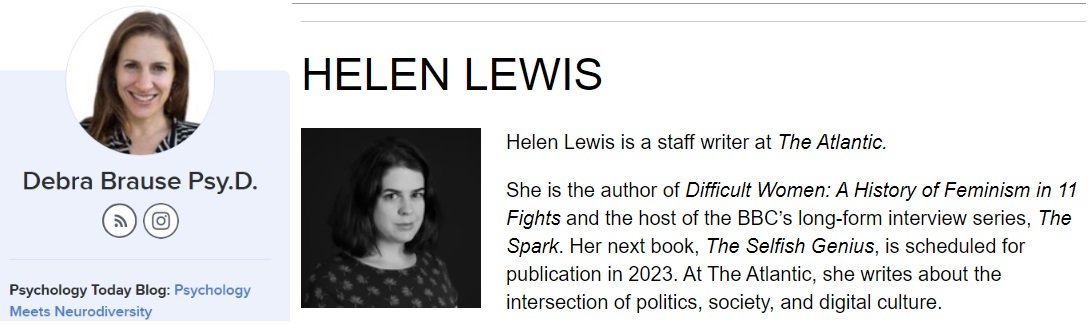
When it comes to facilitated communication, Psychology Today has a mixed record. While a number of its contributors (Amy Lutz, Stephen Camarata, Bill Ahearn, and Scott Lilienfeld) have spoken out against it, others (Chantal Sicile-Kira, Robert Chapman, and Susan Senator) have, to one degree or another, expressed support. Recently joining the second cohort (which consists of a neurodiversity philosopher, an autism consultant, and an autism parent) is a psychologist: Debra Brause, PsychD.

Brause’s post, entitled Nina: A Nonspeaker Who Found Her Voice, showcases a nonspeaking autistic individual who purportedly describes her feelings of being locked inside and unheard by others until she started “using a method called spelling to communicate (S2C), which enables her to share her story.” S2C has also enabled Meehan’s communication partners to conclude that “she is a deep thinker and cares about ‘every single thing’” and also that she’s bilingual:

Not only did Meehan know English, but likely due to exposure to her grandmother’s native language, one day, Meehan spelled in Spanish, “I’m bilingual. I know how to speak Spanish, too.”

Brause is aware of the controversy surrounding facilitated communication (FC) and variants like S2C and RPM (Rapid Prompting Method). But she’s nonetheless confident of her claims. Nor are all of them unreasonable, as we see in her first two bullet points:

  • Access to communication is a fundamental human right.

  • Misconceptions about nonspeaking autism can be harmful.

Indeed; I think we can all agree on those.

But then come the next two bullets, which are, in fact, two harmful misconceptions about nonspeaking autism:

  • Spelling to communicate (S2C) can be a powerful tool for nonspeaking autistic people.

  • Neurotypicals should presume competence and become helpful communication/regulation partners to nonspeakers.

In fact, as a careful read through this website’s research pages (see here and here) will show, all the available evidence indicates that in S2C, as with all other forms of facilitated communication (FC), the facilitator, not the person with disabilities, is controlling the messages. S2C, thus, quite far from being a powerful communication tool for nonspeakers, is likely a major suppressor of their communication rights, as well as being a major detractor from evidence-based therapies that boost—however slightly—the ability of these vulnerable individuals to communicate authentic messages independently.

Additional harms can come from the specific messages and associated desires that are attributed to these individuals. Consider this:

Recently, Meehan met another local speller named Wynston. They started hanging out, and Wynston asked her to be his Valentine. They are forming a deep and loving emotional connection. Through spelling, they can fully express their feelings for each other, and they hope that other spellers out there know that they can build meaningful relationships, too.

What if Meehan actually has no interest in having a relationship with Wynston, and/or vice versa? What happens if Meehan and Wynston are forced to spend time together, even live together, against the will of one or both of them?

And what if Meehan actually has no interest in the causes that are attributed to her through her facilitated output and would rather be doing something entirely different:

She wants to create a school where spellers thrive. She is asking for neurotypicals to see what nonspeakers are capable of and give them the chance to have meaningful opportunities in society. She has created The Nina Foundation to educate the world about autism and raise awareness about autistic people’s ability to comprehend the world around them. According to Meehan, “There is a revolution happening through unlocking the voices of all nonspeakers.”

Nor is presuming competence the right move for neurotypicals who work with nonspeakers on communication—or, for that matter, for anyone who works with anyone on anything. If I were to presume that my special ed students are already competent, say, in understanding what constitutes an autism-friendly learning environment, I would do them (and their future students) a huge disservice. And if certain of my college mathematics professors hadn’t presumed, say, that we students were already competent in abstract math proofs, we all would have become better at constructing and applying these proofs on our own. What good teachers presume isn’t their students’ competence, but their capacity to learn what they don’t yet know.

Brause, however, is confident that we skeptics are wrong. One of her criticisms is that familiar straw man: “there is a common misconception that autistic nonspeakers do not have cognitive ability.” But it’s well known that autistic nonspeakers can excel in nonverbal tasks like puzzles, math, art, and music. What autistic nonspeakers don’t excel in is language. That’s because autistic nonspeakers—unlike nonspeakers with paralysis or deafness—are limited, by their very autism, in their automatic attention to voices and faces and in their ability to figure out the meanings of words.

Another of Brause’s criticisms repeats the “presume competence” fallacy:

When we assume that those without a voice are not verbal, we demean their capability and fail to uncover the intelligence they hold inside.

But the best way to uncover hidden intelligence in those without a voice is to provide evidence-based language instruction; not to assume that they’re already verbal.

Brause also repeats the popular but evidence-free pro-FC claim that apraxia impedes the ability to demonstrate comprehension and that S2C addresses this:

Due to apraxia, a motor movement disorder, many autistic people cannot demonstrate what they understand. Apraxia is a disconnection between the brain and the body, and autistic people often struggle to get their bodies to do what their minds intend. Nonspeakers cannot show their verbal acuity without the motor skills to convey their intelligence.

(For a discussion of why this claim is evidence-free, see this post and its follow-up).

Relatedly, Brause claims that S2C helps these theoretically apraxic individuals bypass their motor challenges:

Spelling to communicate teaches individuals with motor challenges the purposeful motor skills necessary to point to letters as a means of communication. The goal is to achieve synchrony between cognition and motor.

This claim, repeated though it is throughout the promotional material for S2C, is also evidence-free.

Another common pro-FC claim echoed here by Brause is that AAC devices are limiting:

The trouble with many AAC devices is that they are limited to icons and don’t represent natural speech. The devices rely on limited choices that can perpetuate motor loops (getting stuck on one icon or word) that may not reflect what the person really wants to say.

In fact, as we point out most recently here, most electronic AAC devices have ABC or QWERTY keyboard modalities that allow open-ended communication through independent, un-facilitated typing.

Interestingly, the only evidence that Brause cites for the validity of S2C is Jaswal et al.’s highly flawed eye-tracking study, and the only specific item she pulls from this article is the following undigested quote: “Our data suggest that participants actively generated their own text, fixating and pointing to letters they selected themselves.” For critiques of the study’s methodology and conclusions, see here and here.

Rather than citing any evidence that actually supports S2C—there isn’t any—Brause mentions its “rigorous training” and its “prompt hierarchy.” Alas, rigorous training does not a valid practice make. And prompt hierarchies, in the worlds of S2C and other FC variants, simply mean prompts that grow more subtle over time (as cues naturally do). Indeed, this notion is one of the biggest distinctions between FC and evidence-based therapies like ABA. In ABA, prompts are eliminated as soon as possible so that the person learns to perform the targeted skill spontaneously (e.g., communicating an unrehearsed message) without the therapist(s)/assistant(s)/facilitator(s) being present. While such independent, spontaneous performances of previously unmastered skills are routinely achieved in ABA, the same has never been documented in S2C or any other FC variants.

Brause’s other substitute for evidence, in particular for the claim that the S2C facilitator is “never influencing the content of the speller’s message”, is the movie Spellers. (For our critique of this highly problematic S2C documercial, see here).

Elaborating on the question of facilitator influence, Brause is convinced that S2C and RPM are essentially different from traditional FC:

The concern amongst skeptics is that the facilitator is the one conveying their own thoughts. Rapid prompting method (RPM) and S2C, however, differ from FC in that the facilitators do not typically support the child’s hand or arm and instead hold or move a letterboard.

It doesn’t seem to occur to Brause that prompts and letterboard movements (combined with facilitator judgments about which letters have been selected) are just as powerful at guiding messages as supporting a hand or arm. For examples of how this works, see, again, our review of Spellers.

Brause does acknowledge that the American Speech-Language-Hearing Association (ASHA) has a position statement against S2C—though she mentions only the second of ASHA’s two concerns, “lack of scientific validity,” and mysteriously omits its first concern, “prompt dependency.” Brause proceeds to suggest that what’s at issue is simply a lack of evidence and that this lack of evidence is merely the result of insufficient interest and insufficient funding:

This is an emerging field, and having sufficient research means having the necessary interest from the public and funding from large institutions.

Omitted from Brause’s discussion are the following points:

  • Many of us are eager to conduct rigorous message passing tests on interested S2C practitioners; the lack of interest is on the part of practitioners, who uniformly refuse to participate in rigorous message passing tests.

  • Rigorous message passing tests are the only way to determine who is authoring the messages and therefore whether S2C is (a) a valid mode of communication or (b) a communication-suppressing, human-rights-violating procedure.

  • Rigorous message passing tests are inexpensive and do not require funding from “large institutions.”

In assuming that rigorous research has to be expensive, Brause may be thinking of Jaswal’s eye-tracking study, and/or his more recent flashing letters study, both of which use fancy equipment that might, to untrained eyes, lend a veneer of rigor to his work, but which actually bypass straightforward, reliable measures of authorship and instead generate highly indeterminate results.

Brause concludes by citing the criticisms on the pro-FC website United for Communication Choice of ASHA’s position statements against RPM and S2C as “flawed and dangerous,” singling out this quote from speech-language pathologist and “family communication coach” Gabriele Nicolet:

In ASHA’s own language, evidence-based practice includes the inclusion of people’s clinical and lived experiences. To deny someone’s lived experience and call it a hoax is the opposite of what that organization stands for. It’s abhorrent.

The answer that pro-RPM and S2C practitioners refuse to explore, of course, is the question of what is and isn’t indicative of a facilitated person’s lived experience.  And until we conduct rigorous message-passing tests to determine who is authoring the RPM and S2C-generated messages, that question will remain unanswered.

So will the question of whether Meehan actually wants to be in a relationship with Wynston.

Part II: The Journalist

When I first heard that Blocked and Reported, which bills itself as a podcast about Internet nonsense, was running a segment entitled Facilitating Communication (with Helen Lewis), I was hopeful that we’d finally have a wide-reaching, if somewhat offbeat, broadcasting of some powerful FC skepticism.

As it turns out, the show was somewhat of a missed opportunity.

The main problem was that journalist Helen Lewis, a staff writer at the Atlantic, limited herself to traditional FC and to events that occurred many years ago. When going over FC’s early history, Lewis got most of it right—although she referred to Douglas Biklen, who brought FC to the U.S. from Australia, as a “psychologist” and cited one of D.N. Cardinal’s early papers as having positive results for some individuals under controlled conditions (see our critique of that paper here).

Lewis did a pretty good job discussing the ideomotor (Ouija Board) effect and emphasizing the likelihood that FCed messages are entirely controlled by the facilitator—although she claimed, incorrectly, that “Some really did progress to independent communication.” She clarified that that this purportedly successful subset consists of those whose problem “was fundamentally a motor problem,” citing “locked-in syndrome” as her one example. But she added that “You can’t tell just from looking at someone whether they are one of the genuinely locked in people”—neglecting to clarify that “genuinely locked in people,” unlike most of the minimally verbal individuals who are subjected to FC, aren’t born that way and have typically been able to communicate independently prior to whatever injury locked them in.

Lewis went on to discuss such landmarks as the anti-FC exposé Prisoners of Silence, Janyce’s story as recounted in Prisoners of Silence and Janyce’s subsequent anti-FC activism (Lewis is highly appreciative of Janyce!); the pro-FC movie Autism is a World; Dan Engber's New York Times Magazine article about the Anna Stubblefield Case; and, finally, what seems to have been the impetus for this interview: the Anna Stubblefield movie that was released in the UK earlier this year and has yet to air in the U.S.

The closest Lewis comes to acknowledging the newer variants of FC is to discuss David Mitchell’s promotion of Naoki Higashida (The Reason I Jump). She rightfully calls Naoki’s communication a form of FC even though no one touches his arm, noting how suspiciously sophisticated his language is and how much it resembles all the other suspiciously sophisticated FC-generated messages she’s encountered.

But then Lewis suggests that FC is on its way out. She cites the renaming of the Facilitated Communication Institute at Syracuse University (now the Center on Disability and Inclusion), claiming that “it says it doesn’t advocate for things like FC, where there’s ambiguity regarding whether the client or the facilitator is the source of the message.” She apparently didn’t explore the Center’s website thoroughly enough to come across this page, which makes clear that FC is still very much a part of the Center’s activities. Instead, Lewis offers this: “I would say at this point that FC is pretty kind of trashed really.”

Nor does Lewis seem to have any idea of the latest variants of FC that are proliferating all over the country at what appears to be a geometric rate, thanks most recently to that documercial for S2C—which likewise goes unmentioned by Lewis.

Interestingly, Lewis concludes her interview by noting that journalists sometimes get things “catastrophically wrong”, and that, should she ever be caught doing that herself, “it will be a major test of character whether I’ve got the balls to just go ‘Nope, really spooned that one, absolutely sorry to everyone’.”

I’m rooting for Lewis to pass that test.