Wednesday, July 17, 2024

Tell Them It’s Not Hate Speech: FC, facilitator crimes, and the ethically compromised world of disability studies

(Cross-posted at FacilitatedCommunication.org).

Shortly after Netflix released it, just a few weeks ago, the latest facilitated communication documentary became a viral hit. But unlike the other popular, feature-length FC documentaries (Spellers, The Reason I Jump, Deej, Far From the Tree, Wretches and Jabberers, Understanding Autism, A Mother’s Courage, and Autism is a World), this one, Tell Them You Love Me, is critical of FC. That is, instead of presenting facilitated communication as a way to unlock purportedly intact language and literacy skills in non-speaking individuals with intellectual impairments, it shows, with excerpts of Dr. Howard Shane’s message-passing tests in Prisoners of Silence, how facilitators can completely control the facilitated messages.

Might this explain why so many of the pro-FC documentaries won various film festival awards while Tell Them You Love Me, as director Nick August-Perna writes in a recent account, was turned down even for a festival screening?

Gentle but painful emails trickled in from Sundance, SXSW, Tribeca, Sheffield, all letting me know that “after careful consideration,” because of the “massive number of submissions,” they would not be programming the film. And though it was funded in the U.K., not one European festival took the film. Some of these major festivals were transparent about being nervous about the subject matter, while others just sent formulaic responses. One major U.S. festival programmer initially watched the film and wrote me an effusive email saying she couldn’t stop thinking about it and wanted to make sure the world premiere was still available. This is almost always a sure sign. We had a premiere! But after many weeks of silence, I got word that they would be passing. She explained that internal conversations had revealed hesitations from within the programming team. They had “concerns.” They wanted it to be more focused on race while simultaneously including more experts in the disability world. The cautious tone of the rejection email was miles away from the delighted and viscerally positive reaction to the film I received just a month earlier.

Nor, despite “the best sales team a documentary filmmaker could want” was there any interest from networks; they gave “even less feedback than the festivals about why” they weren’t interested. No interest, that is, until Netflix finally bit.

What could all this nervousness and hesitation and concern possibly have been about? Should the documentary really have been “more focused on race”? Judging from the viewer comments I’ve seen so far, that will ring resoundingly false to anyone who watches it. More compelling is the notion that the film should have included “more experts in the disability world.”

This brings us to one of the most baffling things about facilitated communication. Despite its having been thoroughly debunked in the 1990s, and despite all the evidence that facilitators are (however unwittingly) hijacking the voices of some of our most vulnerable citizens, groups that you’d think would be concerned about FC instead appear to support it. I’m thinking, specifically, of self-styled autism and disability rights advocates.

In a couple of old blog posts (here and here), I’ve discussed the widespread support of autism advocates for FC, noting how this enables these folks to:

  • minimize the differences between non-speaking autistics and themselves, thus combating the criticism, made frequently by autism parents, that they cannot speak for those at the other end of the autism spectrum

  • promote the idea that autism is a difference, not a disorder, except inasmuch as disability is some sort of social construct (as in: give everyone a letterboard and a facilitator, and any apparent disorders disappear).

But I haven’t yet addressed the support for FC by disability rights individuals—a support that shows up in the large number of pro-FC articles in disability studies journals: Disability & Society and, especially, Disability Studies Quarterly, which alone has published four pro-FC articles since 2011 (see the references below).

It’s high time to fill that void.

One of the most vociferous, pro-FC disability journal articles comes from the person at the epicenter of Tell Them That You Love Me, the person who gets, by far, the most air time of all: a former Rutgers ethics professor by the name of Anna Stubblefield. As Janyce explained in an earlier piece, Stubblefield is a Syracuse-trained facilitator whose mother, Sandra McClennen, “was a first-generation facilitator and disciple of Douglas Biklen (who brought FC to the U.S. from Australia).”

And as we learn in Tell Them You Love Me, and also in an earlier New York Times exposé, Stubblefield fell in love with one of her clients and used facilitated communication to obtain consent to perform sex acts upon him, one session lasting for hours. Based on these acts and testimony from expert witnesses that FC is a discredited technique and that her client could not have given consent, Stubblefield was found guilty of two counts of first-degree aggravated sexual assault. Although the court overturned Stubblefield's conviction on appeal because of a technicality, she ultimately plead guilty to two counts of third degree assault rather than face a second trial.

One key detail that was left out of the documentary was an article published by Stubblefield the same year in which she began performing sexual acts on her client: an article in Disability Studies Quarterly entitled  “Sound and fury: When opposition to facilitated communication functions as hate speech.”

The article makes a number of claims common to most pro-FC manifestos, namely:

  • Autism and other intellectual disabilities are movement disorders that impede the ability to point to things.

  • Since communication methods other than FC haven’t helped some people communicate much, FC is a reasonable alternative for communication.

  • Individuals whose facilitators no longer touch them must ipso facto be communicating independently.

  • Testimonials elicited through facilitation count as evidence for FC.

  • It’s unreasonable to insist that every time someone is subjected to FC the facilitation should be validated with a message passing test.

  • “FC has been validated as an effective means of communication for some people.”

All of these claims have been debunked by research cited elsewhere on this site, for example here, so I won’t dwell on them in this post.

What’s perhaps more relevant to the question at hand, namely the attempted suppression of Tell Them You Love Me, is Stubblefield’s take on hate speech. This purportedly includes the following—with my annotations added, italicized, in brackets.

  • “dismissing the words of an FC user as unworthy of consideration.” [All the evidence strongly indicates that the words of an FC user are actually the words of the facilitator.]

  • presuming that FC users are intellectually impaired. [All the available evidence suggests that the typical FC user is communicatively impaired, though not necessarily more generally cognitively impaired.]

  • “ignor[ing] explanations other than intellectual impairment for the unreliability of speech and pointing in FC users.” [A straw man. Or perhaps Stufflefield is confusing “ignoring” with “finding fault with.”]

  • “the refusal to seriously consider or provide evidence to refute substantiated argumentation that challenges one's prior beliefs, while issuing unproven assertions that undermine the words of those making or providing evidence for the challenge.” [Isn’t pretty much everyone guilty of this behavior— according to those who most vehemently disagree with them?]

  • “assert[ing] that withholding access to FC protects the rights of people who cannot speak.” [This one speaks for itself.]

  • “denigrating FC supporters” [Denigrating supporters of things one thinks are a really bad idea is routine behavior.]

  • “suggesting that open discussion about FC should be suppressed.” [Another straw man. Plus, it’s those who call FC criticism “hate speech” who are the ones calling for the suppression of open discussion.]

Stubblefield also cites three specific examples of hate speech:

  • A statement by Van Acker (2006) that “FC is predicated on the mistaken assumption that many individuals with severe communicative disorders (e.g., those with autism or severe and profound mental retardation) have a level of ‘undisclosed literacy’ that can be ‘tapped’ through this procedure.”

  • Jacobson et al.’s (1995) statement that “the everyday facility with which people with autism or mental retardation use a language (e.g., spoken, written, or pictorial) is an accurate depiction of their ability to do so and that there is no clinically significant phenomenon that inhibits the overt production of communication and ‘masks’ normative communication.”

  • Jacobson et al.’s (1995) statement that “that there is a strong presumptive relationship, in general, between overt production and actual ability is a cornerstone of psychological assessment methodology, statistics, and psychometrics.”

All I can say is I’m glad Stubblefield hasn’t been put in charge of moderating discussions in psychology and special education, let alone deciding what gets published.

Stubblefield also notes that “Fear mongering claims about FC and false sexual abuse allegations have been a staple of anti-FC rhetoric for years.” Perhaps she would now include her own case as yet another example.

And perhaps her colleagues in disability advocacy would as well. As Mark Sherry reports in an article in Disability & Society, the reaction to this case by disability studies scholars was uniformly in support of Stubblefield:

In all of the posts I saw, there was never a suggestion that people reach out to the family, even though many disability studies scholars met the victim’s brother when he read the victim’s purported paper at the Society for Disability Studies conference. In my opinion, the welfare of the disabled victim should have been paramount. I saw these scholars advocate on behalf of Stubblefield, who is a white, non-disabled woman, but I never saw anything to support the black disabled man who was the victim of this sexual assault. I even witnessed disability scholars soliciting contributions to her legal defense fund, but I never saw a single effort to support the victim. In my view, this response to rape is not only misdirected, it is unethical and shameful. The lack of concern for the victim and his family was chilling, disturbing, and alarming.

Sherry continues:

While the judge said the case was not about facilitated communication per se, many of Stubblefield’s defenders in disability studies stridently defended it, almost as a matter of faith. This was a mistake – facilitated communication is a practice that is demonstrably unscientific and unreliable. Their personal and financial support for Stubblefield must also be called into question. Stubblefield was convicted by a jury of her peers, after a five-week trial, and is now a registered (and incarcerated) sex offender. Given that the courts have found her guilty, it is incumbent upon disability studies scholars to critically examine their support for Stubblefield. Were they inadvertent rape apologists?

Sherry leaves that question unanswered, and so do I. All I can come up with is that, as some sort of accident of history, the field of disability studies was hijacked early on by some of FC’s most fervent believers. Perhaps, by now, they’ve had enough cumulative influence on society in general and on the entertainment industry in particular to have been able to suppress films like Tell Them You Love Me. And perhaps if the gears of history were rewound back, say, to 1980, things could have turned out differently.

I’ll end with two points:

First, there’s the reaction to Tell Them You Love Me by FC’s other most fervent believers: the devotees of Rapid Prompting Method and Spelling to Communicate. Are we hearing cries from them that Stubblefield was unfairly prosecuted because the facilitated consent was actual consent? Or insistent claims that RPM and S2C are different from FC because “no one is touching anyone”? Neither. Instead, there’s deafening silence. It’s as if they’ve all gotten together and decided that the less said, the sooner this movie goes away, and the sooner this movie goes away, the better it is for all of them.

For anyone who truly cares about disability rights, however, Tell Them You Love Me is an absolutely must-see. And this takes us to my final point: If you haven’t seen it yet, watch it tonight. Tell everyone you know to watch it. It’s one of the most fascinating, if disturbing, documentaries currently out there—right up there with Prisoners of Silence.


REFERENCES

Ashby, C., Jung, E., Woodfield, C., Vroman, K., & Orsati, F. (2015). ‘Wishing to go it alone’: The complicated interplay of independence, interdependence and agency. Disability & Society, 30(10), 1474–1489. doi:10.1080/09687599.2015.1108901

Biklen, D., Morton, M. W., Saha, S. N., Duncan, J., Gold, D., Hardordottir, M., Karna, E., O’Connor, S., & Rao, S. (1991). I AMN OT A UTISTIVC ON THJE TYP. Disability, Handicap & Society, 6, 161–179. doi:10.1080/02674649166780231

Jacobson, J., Mulick, J., and Schwartz, A. 1995. "A History of Facilitated Communication: Science, Pseudoscience, and Antiscience Science Working Group on Facilitated Communication." American Psychologist 50, 750-765

McKee, A., & Gomez, A. (2020). The voices of typers: Examining the educational experiences of individuals who use facilitated communication. Disability Studies Quarterly, 40(4). Advance online publication. doi:10.18061/dsq.v40i4.6981

Savarese, R. J., & Savarese, E. T. (2011). The superior half of speaking: An introduction. Disability Studies Quarterly, 30(1). Advance online publication. doi:10.18061/dsq.v30i1.1062

Sherry, M. (2016). Facilitated communication, Anna Stubblefield and disability studies. Disability & Society, 31(7), 974–982. https://doi.org/10.1080/09687599.2016.1218152

Stock, B. (2011). Mixed messages: Validity and ethics of facilitated communication. Disability Studies Quarterly, 31(4). Advance online publication. doi:10.18061/dsq.v31i4.1725

Stubblefield, A. (2011). Sound and fury: When opposition to facilitated communication functions as hate speech. Disability Studies Quarterly, 31(4). Advance online publication. doi:10.18061/dsq.v31i4.1729

Van Acker, Richard. 2006. Outlook on Special Education Practice. Focus on Exceptional Children 38, 8-18.

Wilson, M., de Jonge, D., de Souza, N., & Carlson, G. (2014, January). Facilitated communication training: Exploration of perceptions of ability and reducing physical support. Disability Studies Quarterly, 34(1). Advance online publication. doi:10.18061/dsq.v34i1.1741

Monday, July 8, 2024

Recapping some reasons why language is impaired in autism—and why degree of impairment correlates with autism severity

 …With some implications for FC. [Cross-posted at FacilitatedCommunication.org].

For infants to pick up language, they need to tune into it. That means preferentially tuning into the sounds of speech over non-speech sounds. Furthermore, they need to link speech sounds to meaning. This means tuning into the people who make those sounds—and, especially, to their eyes: where a speaker’s eyes are pointing indicates who the speaker is speaking to and/or what they speaking about. Speech, people, eyes: these are the key ingredients of social stimuli.

The less a child tunes into social stimuli, therefore, the less he or she will pick up language. The earlier in development this process is derailed, the greater the effects on language. At least eight studies of children 6 months and younger who are “at risk for autism”—that is, infants with an older autistic sibling—show that, in autism, this derailment begins early in development (bold-face added):

  • Jones and Klin (2013): “infants later diagnosed with autism spectrum disorders (ASDs) exhibit mean decline in eye fixation from 2 to 6 months of age, a pattern not observed in infants who do not develop ASD.”

  • Lloyd-Fox et al. (2013): “In a functional near-infrared spectroscopy study, infants aged 4–6 months at risk for autism showed less selective neural responses to social stimuli (auditory and visual) than low-risk controls…. Further, these differences closely resemble known patterns of neural atypicality in children and adults with autism.”

  • Lloyd-Fox et al. (2017): “At 4-6 months, infants who went on to develop ASD at 3 years (N = 5) evidenced reduced activation to visual social stimuli relative to low-risk infants (N = 16) across inferior frontal (IFG) and posterior temporal (pSTS-TPJ) regions of the cortex. Furthermore, these infants also showed reduced activation to vocal sounds and enhanced activation to non-vocal sounds within left lateralized temporal (aMTG-STG/pSTS-TPJ) regions compared with low-risk infants and high-risk infants who did not develop ASD (N = 15).”

  • Blanco et al. (2023): “infants at elevated likelihood of ASD showed attenuated responses to visual social stimuli in several cortical regions compared to infants at typical likelihood. Individual brain responses to visual social stimuli were associated with later autism traits... These outcomes support our previous observations showing atypical social brain responses in infants at elevated likelihood of ASD and align with later atypical brain responses to social stimuli observed in children and adults with ASD.” (Average age: 166 days).

  • Blasi et al. (2015): “we used functional MRI to examine cortical sensitivity to auditory stimuli in infants at high familial risk for later emerging ASD (HR group, N = 15), and compared this to infants with no family history of ASD (LR group, N = 18)… Whereas LR infants showed early specialisation for human voice processing in right temporal and medial frontal regions, the HR infants did not. Similarly, LR infants showed stronger sensitivity than HR infants to sad vocalisations in the right fusiform gyrus and left hippocampus.”

  • Jones et al. (2016): “High-risk infants who met criteria for ASD at 24 months showed shorter epochs of visual attention, faster but less prolonged neural activation to faces, and delayed sensitization responses (increases in looking) to faces at 6 months; these differences were less apparent at 12 months. These findings are consistent with disrupted engagement of sustained attention to social stimuli.”

  • Chawarska et al. (2013): “6-month-old infants later diagnosed with ASD attended less to the social scene, and when they did look at the scene, they spent less time monitoring the actress in general and her face in particular.“

  • Mastro et al. (2002):

    • “Fifteen home movies from the first 6 months of life of children who later received a diagnosis of ASD were compared with home movies of 15 normal children… found significant differences between the two groups for the items in the social attention and the social behavior areas; on the contrary, there were no differences in nonsocial attention.”

    • “The significant differences in items regarding interest in other persons confirm that children with ASD reveal a preference for nonsocial stimuli. Attention toward objects does not distinguish autistic from normal infants: object exploration, involving a few activity patterns, such as mouthing, waving, and banging, tended to be the same in both groups. This result probably means that attention is not implicated as a primary function but as an elective function only toward social stimuli. In short, infants with autism exhibited a specific qualitative pattern of attention, highly consistent with theories predicting that ASD children have a specific deficit in attending social stimuli.”

These patterns continue in older autistic children:

  • Adamson et al. (2021). “Toddlers with ASD usually appeared aware of a new sound, often alerting to and orienting toward it. But compared to TD toddlers and toddlers with DD, they alerted and oriented less often to speech, a difference not found with the other sounds. Furthermore, toddlers with ASD were far less likely to spontaneously try to share the sound with the parents and to engage with the parent and the sound when parents tried to share it with them.” (Average age: 22.6 months).

  • Kuhl et al. (2005): “In this study, we examined social and linguistic processing of speech in preschool children with autism spectrum disorder (ASD) and typically developing chronologically matched (TDCA) and mental age matched (TDMA) children. The social measure was an auditory preference test that pitted 'motherese' speech samples against non-speech analogs of the same signals. The linguistic measure was phonetic discrimination assessed with mismatch negativity (MMN), an event-related potential (ERP). As a group, children with ASD differed from controls by: (a) demonstrating a preference for the non-speech analog signals, and (b) failing to show a significant MMN in response to a syllable change.” (Average age: 45.31 months).

  • Klin (1991): “[Participants] were given a choice between their mothers' speech and the noise of superimposed voices (a sound effect obtained in a busy canteen). Data were obtained utilizing a specially designed automated and computerized device which recorded the children's responses in their own homes. In contrast to comparison groups of mentally retarded and normally developing children who showed the expected strong preference for their mothers' speech, the autistic children actively preferred the alternative sound or showed a lack of preference for either audio segment. These results suggest that such abnormal reactions to speech are a feature of these children's overall disregard to people.” (Average age: 63.5 months.)

  • Dawson et al (1998): “It was found that, compared to children with Down syndrome or typical development, children with autism more frequently failed to orient to all stimuli, and that this failure was much more extreme for social stimuli. Children with autism who oriented to social stimuli took longer to do so compared to the other two groups of children. Children with autism also exhibited impairments in shared attention.” (Average age: 64.6 months)

  • Magreli et al. (2013): “While the two groups orient overtly to facial expressions, children with ASC do so to a lesser extent. Children with ASC differ importantly from TD children in the way they respond to speech cues, displaying little overt shifting of attention to speaking faces. When children with ASC orient to facial expressions, they show reaction times and first fixation lengths similar to those presented by TD children. However, children with ASC orient to speaking faces slower than TD children. These results support the hypothesis that individuals affected by ASC have difficulties processing complex social sounds and detecting intermodal correspondence between facial and vocal information.” “The impairment in social orienting to speech sound seems more severe than that observed with facial expressions.”  (Average age: 6.08 years).

  • ÄŚeponienÄ— et al., (2003): “Acoustically matched simple tones, complex tones, and vowels were presented in separate oddball sequences, in which a repetitive "standard" sound was occasionally replaced by an infrequent ‘deviant’ sound differing from the standard in frequency (by 10%)… The sensory sound processing was intact in the high-functioning children with autism and was not affected by sound complexity or ‘speechness.’ In contrast, their involuntary orienting was affected by stimulus nature. It was normal to both simple- and complex-tone changes but was entirely abolished by vowel changes. These results demonstrate that, first, auditory orienting deficits in autism cannot be explained by sensory deficits and, second, that orienting deficit in autism might be speech-sound specific.” (Average age: 8.4 years).

  • Lepistö et al. (2005): “involuntary orienting to sound changes, as reflected by the P3a ERP, was more impaired for speech than non-speech sounds in the children with autism, suggesting deficits particularly in social orienting. This has been proposed to be one of the earliest symptoms to emerge, with pervasive effects on later development.”

In addition, the degree to which these individuals tune in is correlated with autism severity, especially in terms of social symptoms like joint attention:

  • Lloyd-Fox et al. (2017): “The degree of activation to both the visual and auditory stimuli correlated with parent-reported ASD symptomology in toddlerhood.”

  • Blasi et al. (2015): “Also, in the HR group only, there was an association between each infant's degree of engagement during social interaction and the degree of voice sensitivity in key cortical regions.”

  • Kuhl et al. (2005): “Participants with a strong preference for non-speech analogs tended to score lower on measures of initiating joint attention and expressive language.”

The connection to autism severity, together with the connection between attending to social stimuli and learning language, adds to the evidence I discussed in my last post: the evidence against the assumption that those who are most likely to be subjected to FC/RPM/S2C understand the sophisticated linguistic content that is attributed to them.

It’s worth noting, however, that one standard measure of autism severity, the ADOS Calibrated Severity Score (Gotham et al., 2009), controls for language levels, and thereby factors out the correlation between autism severity and language skill. To see the connection between language and autism severity, therefore, one must use raw, un-calibrated ADOS scores, or other measures—for example the various measures of social attention explored in the 15 studies reviewed here.


REFERENCES:

Adamson, L. B., Bakeman, R., Suma, K., & Robins, D. L. (2021). Autism Adversely Affects Auditory Joint Engagement During Parent-toddler Interactions. Autism research : official journal of the International Society for Autism Research, 14(2), 301–314. https://doi.org/10.1002/aur.2355

Blanco, B., Lloyd-Fox, S., Begum-Ali, J., Pirazzoli, L., Goodwin, A., Mason, L., Pasco, G., Charman, T., Jones, E. J. H., Johnson, M. H., & BASIS/STAARS Team (2023). Cortical responses to social stimuli in infants at elevated likelihood of ASD and/or ADHD: A prospective cross-condition fNIRS study. Cortex; a journal devoted to the study of the nervous system and behavior, 169, 18–34. https://doi.org/10.1016/j.cortex.2023.07.010

Blasi, A., Lloyd-Fox, S., Sethna, V., Brammer, M. J., Mercure, E., Murray, L., Williams, S. C., Simmons, A., Murphy, D. G., & Johnson, M. H. (2015). Atypical processing of voice sounds in infants at risk for autism spectrum disorder. Cortex; a journal devoted to the study of the nervous system and behavior, 71, 122–133.

ÄŚeponienÄ—, R., Lepistö, T., Shestakova, A., Vanhala, R., Alku, P., Näätänen, R., & Yaguchi, K. (2003). Speech-sound-selective auditory impairment in children with autism: they can perceive but do not attend. Proceedings of the National Academy of Sciences of the United States of America, 100(9), 5567–5572. https://doi.org/10.1073/pnas.0835631100

Chawarska, K., Macari, S., & Shic, F. (2013). Decreased spontaneous attention to social scenes in 6-month-old infants later diagnosed with autism spectrum disorders. Biological psychiatry, 74(3), 195–203. https://doi.org/10.1016/j.biopsych.2012.11.022

Dawson, G., Meltzoff, A. N., Osterling, J., Rinaldi, J., & Brown, E. (1998). Children with autism fail to orient to naturally occurring social stimuli. Journal of autism and developmental disorders, 28(6), 479–485. https://doi.org/10.1023/a:1026043926488

Dziuk, M. A., Gidley Larson, J. C., Apostu, A., Mahone, E. M., Denckla, M. B., & Mostofsky, S. H. (2007). Dyspraxia in autism: association with motor, social, and communicative deficits. Developmental medicine and child neurology, 49(10), 734–739. https://doi.org/10.1111/j.1469-8749.2007.00734.x

Gotham, K., Pickles, A., & Lord, C. (2009). Standardizing ADOS scores for a measure of severity in autism spectrum disorders. Journal of autism and developmental disorders, 39(5), 693–705. https://doi.org/10.1007/s10803-008-0674-3

Jones, E. J., Venema, K., Earl, R., Lowy, R., Barnes, K., Estes, A., Dawson, G., & Webb, S. J. (2016). Reduced engagement with social stimuli in 6-month-old infants with later autism spectrum disorder: a longitudinal prospective study of infants at high familial risk. Journal of neurodevelopmental disorders, 8, 7. https://doi.org/10.1186/s11689-016-9139-8

Jones, W., & Klin, A. (2013). Attention to eyes is present but in decline in 2-6-month-old infants later diagnosed with autism. Nature, 504(7480), 427–431. https://doi.org/10.1038/nature12715

Klin A. (1991). Young autistic children's listening preferences in regard to speech: a possible characterization of the symptom of social withdrawal. Journal of autism and developmental disorders, 21(1), 29–42. https://doi.org/10.1007/BF02206995

Kuhl, P. K., Coffey-Corina, S., Padden, D., & Dawson, G. (2005). Links between social and linguistic processing of speech in preschool children with autism: behavioral and electrophysiological measures. Developmental science, 8(1), F1–F12. https://doi.org/10.1111/j.1467-7687.2004.00384.x

Lepistö, T., Kujala, T., Vanhala, R., Alku, P., Huotilainen, M., & Näätänen, R. (2005). The discrimination of and orienting to speech and non-speech sounds in children with autism. Brain research, 1066(1-2), 147–157. https://doi.org/10.1016/j.brainres.2005.10.052

Lloyd-Fox, S., Blasi, A., Elwell, C. E., Charman, T., Murphy, D., & Johnson, M. H. (2013). Reduced neural sensitivity to social stimuli in infants at risk for autism. Proceedings. Biological sciences, 280(1758), 20123026. https://doi.org/10.1098/rspb.2012.3026

Lloyd-Fox, S., Blasi, A., Pasco, G., Gliga, T., Jones, E. J. H., Murphy, D. G. M., Elwell, C. E., Charman, T., Johnson, M. H., & BASIS Team (2018). Cortical responses before 6 months of life associate with later autism. The European journal of neuroscience, 47(6), 736–749. https://doi.org/10.1111/ejn.13757

Maestro, S., Muratori, F., Cavallaro, M. C., Pei, F., Stern, D., Golse, B., & Palacio-Espasa, F. (2002). Attentional skills during the first 6 months of age in autism spectrum disorder. Journal of the American Academy of Child and Adolescent Psychiatry, 41(10), 1239–1245. https://doi.org/10.1097/00004583-200210000-00014

Magrelli, S., Jermann, P., Noris, B., Ansermet, F., Hentsch, F., Nadel, J., & Billard, A. (2013). Social orienting of children with autism to facial expressions and speech: a study with a wearable eye-tracker in naturalistic settings. Frontiers in psychology, 4, 840. https://doi.org/10.3389/fpsyg.2013.00840

Mostofsky, S. H., & Ewen, J. B. (2011). Altered connectivity and action model formation in autism is autism. The Neuroscientist : a review journal bringing neurobiology, neurology and psychiatry, 17(4), 437–448. https://doi.org/10.1177/1073858410392381

Torres, E. B., Brincker, M., Isenhower, R. W., Yanovich, P., Stigler, K. A., Nurnberger, J. I., Metaxas, D. N., & JosĂ©, J. V. (2013). Autism: the micro-movement perspective. Frontiers in integrative neuroscience, 7, 32. https://doi.org/10.3389/fnint.2013.00032

Thursday, July 4, 2024

Recent findings about language comprehension in minimal speakers with autism

(Cross-posted at FacilitatedCommunication.org).

A recent paper on language in autism has some interesting implications for facilitated communication and its variants.

But first, some context. Most studies of language skills in autistic individuals combine language production skills (mostly in spoken language) and comprehension skills (mostly of spoken language). When they examine distinctive facets of language like pronunciation, vocabulary, syntax, and pragmatics, they tend not to systematically disentangle comprehension from production. Vocabulary is often measured by comprehension: does the child point to, or look at, the picture of the “cup” when the word “cup” is spoken? Syntax tends to be measured by production: the child repeats a sentence or generates a sentence from a picture prompt, or observations are made of a child’s spoken language in real-life contexts. Pragmatics may be measured through judgments (or parent surveys) of the social appropriateness of the person’s utterances and/or the person’s judgments of the social appropriateness of hypothetical utterances by other people in different contexts.

Despite these common practices, separating comprehension from production and measuring a person’s comprehension of words, sentences, and socially embedded communications (directions, conversations, narratives) is arguably the best way to establish a person’s linguistic capabilities. That’s because comprehension precedes, and is a prerequisite for, meaningful speech. If one speaks without comprehension, that doesn’t really count as language; if one speaks hardly at all but understands a great deal, that does count as language—significant language.

Knowing a person’s language comprehension skills is crucial for making the following key determinations:

  • how much they’re taking in when people talk to them
  • how much information they’re able to learn through verbally presented material
  • how much they understand of what they’re saying or typing when they speak or type

And here’s where the connection to FC comes in: a person’s typed-out messages cannot possibly be coming from that person if he or she doesn’t understand the words, phrases, syntax structures, and informational content that comprise those messages.

Then there’s the connection to autism: language comprehension difficulties have been found to be more essentially connected to autism than language production difficulties are. That’s because comprehension necessarily involves something that is inherently challenging in autism: turning into other people and getting inside their heads. To understand what a specific word refers to, or what an entire spoken or written message means, you need to figure out what the speaker/writer is referring to, and/or what their subtext is, and/or what their purpose is.

Few papers, as I said, have focused specifically on comprehension in autism, but a new paper has just come out that helps to fill this gap: Vyshedskiy et al. (2024).

On one hand, Vyshedskiy et al.’s language comprehension data doesn’t come from the most reliable source: they used parent surveys rather than professional assessments. On the other hand, their sample was huge and broad: 31,845 autistic individuals from 4 to 21 years of age.

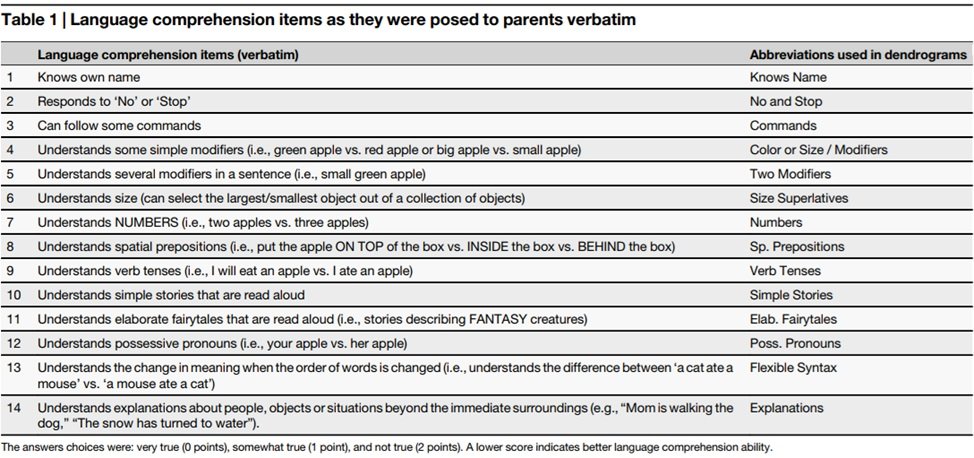
To measure language comprehension, they used this:

The first nine of these questions—from “knows own name” to “understands verb tenses (i.e. I will eat an apple vs. I ate an apple”)—look straightforward and specific enough to be amenable to objective answers. So do questions 12 and 13. In some cases, the parent might not know the answer offhand, but the questions make it clear how to prompt the child to figure it out.

Only questions 10, 11, and 14 are potentially problematic, focusing on linguistic phenomena—stories and explanations—where it may be easy (and even tempting) to read in more comprehension than really is there.

To measure factors other than comprehension—including expressive language, sociability, and sensory sensitivities—the authors used something called the “ATEC questionnaire.” (They state that “Various studies confirmed validity and reliability of ATEC”).

As for the authors’ methodology, this was potentially more objective than what’s possible with smaller data sets. Rather than trying to make the data fit pre-existing assumptions, they used an automated, unsupervised cluster analysis to determine which non-linguistic factors correlated with which comprehension profiles. And their results, as it turns out, are not particularly convenient for FC proponents.

Their cluster analysis identified three distinct levels of language comprehension:

  • individuals in the command-language-phenotype, who were limited to comprehension of simple commands (40% of the sample)
  • individuals in the modifier-language-phenotype, who could also comprehend color, size, and number modifiers (43% of the sample)
  • individuals in the syntactic language-phenotype, who could also comprehend spatial prepositions, verb tenses, flexible syntax, possessive pronouns, and complex narratives. (17% of the sample)

And here’s what the cluster analysis showed:

Participant clusters displayed statistically significant differences in properties that were not used for clustering, such as expressive language, sociability, sensory awareness, and health… demonstrating that language comprehension phenotypes are associated with symptom severity in individuals with ASD. [Boldface mine].

In particular, the authors report:

  • The syntactic language phenotype had the greatest proportion of individuals characterized by parents as having mild ASD and the lowest proportion of individuals with severe ASD.
  • The command language phenotype had the greatest proportion of individuals characterized by parents as having severe ASD and the lowest proportion of individuals with mild ASD.

Since those most likely to be subjected to FC are those with the most severe autism symptomology, this finding adds to the mounting evidence that those subjected to FC do not have the comprehension skills to author the linguistically sophisticated messages that are attributed to them.

In addition, the authors find the following connection to expressive language skills:

91% of children in the command language phenotype were nonverbal or minimally verbal, compared to 68% in the modifier language phenotype, and 33% in the syntactic language phenotype.

Since those most likely to be subjected to FC are minimally verbal individuals, this finding also adds to the mounting evidence against the purported authorship skills of those subjected to FC.

But what about the finding that 33% of individuals in the highest comprehension group are minimally verbal?

It’s possible that some of those individuals fell into that cluster, in part, because their parents over-estimated their comprehension of stories and explanations—a possibility I suggested earlier. Intriguingly, however, this is not the first time evidence has emerged of a subset of minimally verbal individuals with relatively intact comprehension skills. About a year ago, I wrote a blog post that reported on a study presented at the 2023 INSAR conference—a study that has since been published (Chen et al., 2024).

Like Vyshedskiy et al., Chen et al. looked at comprehension. Their sample consisted of 1579 minimally speaking autistic children, and they found that:

  • minimally speaking autistic children had much lower receptive language skills (comprehension skills) compared to their neurotypical peers
  • this gap widened with age
  • receptive language skills correlated with social skills (and thus with one component of autism severity)

And like Vyshedskiy et al., they found that there exists a subset of minimal speakers—about 25% of their sample—in which receptive language skills are relatively high relative to expressive skills (e.g., speaking skills). However, they also found that the receptive language skills even of this unusual subgroup

  • are still lower than those of same-aged, non-autistic individuals
  • are positively associated with motor skills.

That is, as Chen puts it in a video describing her findings:

[I]n this subgroup, motor skills emerge as the only significant factor predicting the discrepancies between receptive and expressive language [language comprehension and language production] above and beyond all other factors. And those with better motor skills are more likely to have much better receptive language than expressive language.

And this amounts to one more piece of evidence that those who are supposedly most in need of FC—i.e., because of their purported motor difficulties—also have the worst receptive language skills.


References:

Chen, Y., Siles, B., & Tager-Flusberg, H. (2024). Receptive language and receptive-expressive discrepancy in minimally verbal autistic children and adolescents. Autism research : official journal of the International Society for Autism Research, 17(2), 381–394. https://doi.org/10.1002/aur.3079

Vyshedskiy, A., Venkatesh, R. & Khokhlovich, E. (2024). Are there distinct levels of language comprehension in autistic individuals – cluster analysis. npj Mental Health Res 3, 19. https://doi.org/10.1038/s44184-024-00062-1

Wednesday, June 26, 2024

Friday, June 14, 2024

On Chalk & Talk--Math and Autism with Anna Stokke

 In which we discuss Direct Instruction, Precision Teaching and--of course!--math instruction meets facilitated communication:

https://chalkandtalkpodcast.podbean.com/

Tuesday, June 11, 2024

Has AI gotten any better at reading since 2019?

 …2019 being the year that Gary Marcus and Ernest Davis published Rebooting AI and discussed the inability of AI to handle passages like this one, from Laura Ingalls Wilder’s Farmer Boy:

Almanzo turned to Mr. Thompson and asked, “Did you lose a pocketbook?” 

Mr. Thompson jumped. He slapped a hand to his pocket and fairly shouted. “Yes, I have! Fifteen hundred dollars in it, too! What about it? What do you know about it?” 

“Is this it?” Alamanzo asked. 

“Yes, yes, that’s it!” Mr. Thompson said, snatching the pocketbook. 

He opened it and hurriedly counted the money. He counted the bills over twice… 

Then he breathed a long sigh of relief and said, “Well this durn boy didn’t steal any of it.”

They find that AI fails to answer questions like:

  • Why did Mr. Thompson slap his pocket with his hand?
  • Before Almanzo spoke, did Mr. Thompson realize that he had lost his wallet?
  • What is Almanzo referring to when he asks “Is this it?”
  • Who almost lost $15,00?
  • Was all of the money still in the wallet?

So I fed Gemini the same passage and asked it the same questions.

Gemini did well on the first question:

The passage describes Mr. Thompson being worried about his lost pocketbook. After Almanzo asked him if he had lost a pocketbook, the text says that “Mr. Thompson jumped. He slapped a hand to his pocket and fairly shouted.” This suggests that Mr. Thompson slapped his pocket to check if his pocketbook was still there. In other words, he was likely worried that he had lost it.

It didn’t do so well on the second: 

The passage doesn’t explicitly tell us if Mr. Thompson realized his wallet was missing before Almanzo spoke. Here’s why: The passage starts with Almanzo asking about a lost “pocketbook,” not mentioning Mr. Thompson’s awareness. Mr. Thompson’s reaction (jumping and slapping his pocket) could be due to either suddenly realizing it’s missing or simply confirming a nagging suspicion. There isn’t enough information to definitively say whether Mr. Thompson knew beforehand.

In its answer to the third question, it’s slightly off, identifying “it,” rather than “this,” as the item that refers to the wallet in Almanzo’s hand (as opposed to the wallet that was lost):

In the passage, when Almanzo asks “Is this it?”, he’s most likely referring to the pocketbook he holds (or possibly points to) that belongs to Mr. Thompson. 
Here’s why: 
The conversation revolves around a lost “pocketbook” that Almanzo mentions first. Mr. Thompson reacts strongly to the question, suggesting he recognizes the object as his missing belonging. He then snatches the “it” in question and confirms it’s his lost pocketbook. Therefore, “it” refers to the physical pocketbook Almanzo has presented to Mr. Thompson.

In its answer to the fourth and fifth questions, Gemini gets back on track:

From the passage, it was Mr. Thompson who almost lost $1,500. The text says he had that amount in the “pocketbook” and reacted with relief upon finding it.

...

The passage suggests that all the money was still in the wallet. Here’s why: Mr. Thompson snatches the wallet back and hurriedly counts the money. He counts the bills “over twice,” implying a thorough check. Finally, he breathes a sigh of relief and says, “Well this durn boy didn’t steal any of it.” This sequence suggests Mr. Thompson found all the money he was expecting to find, leading to his relief. There’s no mention of missing money.

But when I asked it a fifth question that doesn’t appear in Rebooting AI, things fell apart:

Unfortunately, the passage doesn’t give us a clear answer about who Mr. Thompson refers to as “this durn boy.” 

Here’s why: 

A general statement of relief without a specific boy in mind. There’s no mention of any other boys in the scene. 

It’s unclear if Mr. Thompson suspected someone (possibly a boy) of stealing the wallet before Almanzo found it. His relieved statement, “Well this durn boy didn’t steal any of it,” could be: 

  • Directed at himself for possibly misplacing the wallet and fearing a boy might have found it.
  • A general statement of relief without a specific boy.

Saturday, June 1, 2024

Some possible revelations on what goes on in facilitators’ heads when they facilitate big projects

(Cross-posted at FacilitatedCommunication.org.)

In this post, I return to one of the news stories I included in my FC news roundup from two weeks ago: a story on KQED’s California Report Magazine about a non-speaking 19-year-old who, after a breakthrough at age 16, defied impressions that, as reporter Sasha Khokha puts it, “he didn’t have the motor skills to point to the right answers in school.” The boy, who now goes by Jacob, was, purportedly, suddenly able to slowly type out full sentences with everything spelled correctly.

In one of the accompanying photographs, we can see Jacob engaging in the typical RPM/S2C-style of letter-selection, with someone else holding up a device to his extended index finger. We can also see a reference in the caption to a neurologist who “confirms that even though his father holds the device for him, Jacob types independently.” That neurologist, later identified as Dr. Margaret Bauman, has a history of defending FC, and it’s unclear on what basis she confirmed Jacob’s independence. In fact, the only way to establish independence is through a rigorous message-passing test in which the facilitator is reliably blinded. Bauman has been involved in only one published message-passing test, back in 1996. As we discuss here, that test was very far from rigorous.

Here comes the part I didn’t get to in my earlier post. According to the article, which is titled “Non-Verbal Teen to 'Take on the World' With a Symphony Written in His Head”:

Six months after learning to type, Jacob surprised his parents again. He told them he had a 70-minute symphony in his head… It’s called Unforgettable Sunrise.

Since Jacob can neither sing nor play an instrument (nor, apparently, read music), one of Jacob’s father’s collaborators, composer Rob Laufer, was brought in to translate Jacob’s verbal descriptions of the 6-movement, 70-minute symphony into a musical score on paper. Laufer, purportedly, “was amazed at the precision of Jacob’s vision for the symphony.”

But what, exactly, did it take for Laufer to translate Jacob’s vision onto paper? In the next dozen paragraphs I’m going to embark on what might seem like an off-topic excursion into symphonic composition and the translation of mental music into musical scores. But my objective here is to explore a broader question:

What is going on in the minds of parents and other facilitators when they assist minimally verbal individuals with nonverbal tasks and large projects that go beyond a few pages worth of typed output?

And my goal, once I emerge from this musical excursion towards the end of this post, is to formulate some possible answers that came to me only as I read and listened to this fascinating—if irresponsible—KQED report.

An excursion into classical music composition and translating mental music into notes on paper

People who attend classical music concerts regularly see multi-paragraph-long descriptions of the pieces being performed. Here’s an excerpt from the program notes of a recent Philadelphia Orchestra concert describing the first movement of Bruckner’s 4th symphony:

After a nocturnal string tremolo that opens the first movement (Bewegt, nicht zu schnell), the horn announces the sunrise and the dawn of a new day for hunting. The theme is eventually taken up by the rest of the orchestra and developed using Bruckner’s favorite rhythm of two beats followed by a triplet. A lighthearted second theme appears first in the strings, evoking the gentle folk-dance flavor that Mahler would later allude to in the Ländler movements of some of his symphonies. The main “horn call” motif then opens the development section, which ebbs and flows around a brief treatment of the second theme and further development of the “Bruckner rhythm,” culminating in a majestic brass chorale garlanded with string tremolos. This sets up the recapitulation, where the first theme is embroidered with an added flute solo, and the second theme is harmonically enriched with unusual modulations. An extended coda prepares for a triumphant return to E-flat at the conclusion.

—Luke Howard

Imagine, first, how long it would take someone extending an index finger to a held-up keyboard to type all this out.

Imagine, second, whether anyone reading this passage who had never heard Bruckner’s 4th symphony before, even if he is a skilled composer, could possibly translate it into the actual melodies, chords, rhythm, and orchestration of Bruckner’s 4th symphony. As pianist and conductor Daniel Barenboim writes in a recent New York Times Op-Ed, “when we try to describe music with words, all we can do is articulate our reactions to it, and not grasp music itself.”

Perhaps a better way to grok what it takes for Person B to transcribe music from Person A’s head into notes on paper, with little other than Person A’s words to guide them, is to watch this scene from the movie Amadeus. Here Salieri sits at the foot of Mozart’s deathbed and attempts to transcribe, from Mozart’s verbal directions and humming, a short passage of the requiem that Mozart has inside his pillow-propped head. While this scene gives us some idea of what’s involved, though, even it strains credulity. Amadeus takes many liberties not just with Mozart’s life, but also with what Salieri can realistically glean from what comes out of Mozart’s mouth.

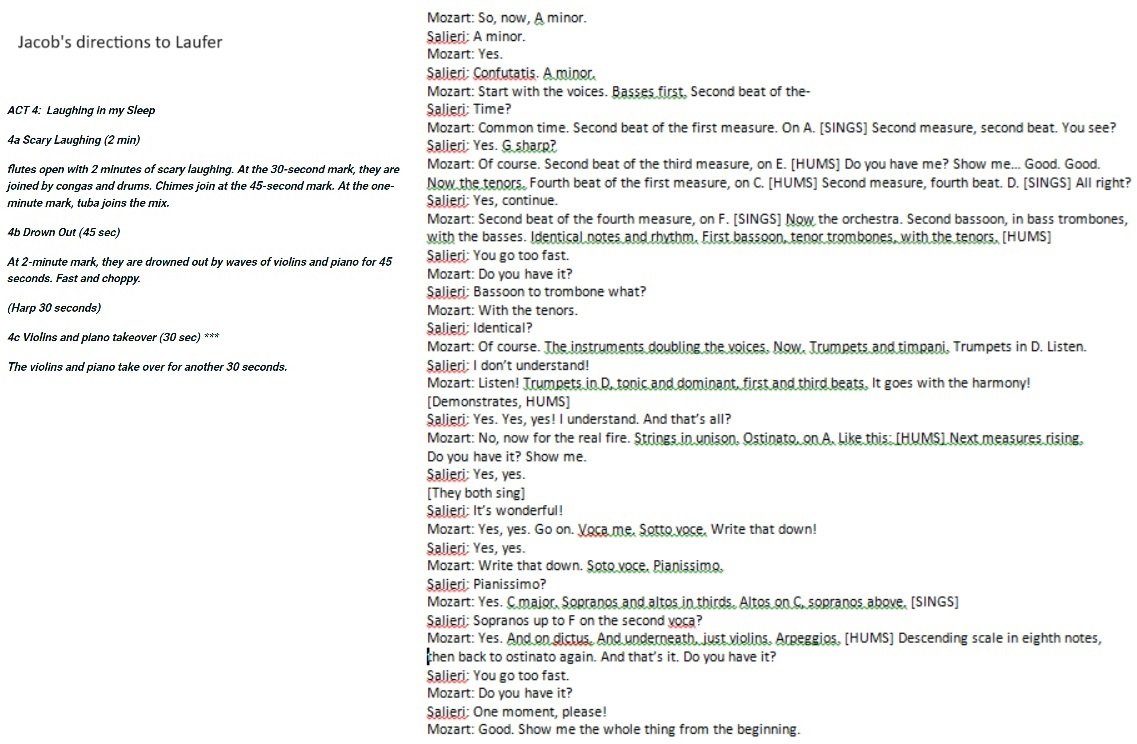
What’s crucial here, however, is that the Mozart character uses not just ordinary words, but musical terms, and, in addition, that he frequently illustrates melodies by humming them. Finally, since he can read music, he can check Salieri’s transcription. Here’s an excerpt from the scene:

Strings in unison. Ostinato, on A. Like this: [HUMS] Next measures rising. Do you have it? Show me.

In contrast, Jacob’s directions consist of words only: words about specific instruments, specific actions or emotions, and the number of iterations and/or for how long. For example:

It starts with piano bangs. Five bursts of cacophony.

In response to this particular prompt, Laufer had to guess the specific chords. He reports hypothesizing that Jacob might have in mind “this chord that I used to think about when I was young that I associated with the end of the world.” So Laufer played a specific chord he used to think about for Jacob, who apparently confirmed it as exactly what he had in mind—presumably by poking out some sort of affirmation on the keyboard held up by his father. In contrast to Mozart checking Salieri’s transcription, Jacob can only type “yes” or “no.“ But conveniently—because otherwise there could have been an endless back and forth—of all the tens of thousands of possible sets of five bangs within the 88 keys of the piano, Laufer guessed the correct ones.

Some of Jacob’s directions are more emotional:

I want triumph and happiness followed by terrified laughter and grief over so many years of painful silence.

Others more poetic:

The violins are demanding sleep and the horns are demanding pain. They battle for 3 minutes of call and response until the horns realize that they are defeated (Every manic horn met by soaring violin).

But while a skilled composer might translate these prompts into music that evokes them, countless translations are possible, and the chance of any particular one matching the music in someone else’s head is close to nil.

At this point, it might be interesting to contrast a sequence of prompts attributed to Jacob to a sequence of prompts attributed to Mozart in Amadeus.

It’s hard to imagine how Laufer could have translated a 70-minute symphony from thousands of prompts like the ones on the left unless most of the time he guessed correctly. But Laufer suggests this is more or less what happened: Jacob’s directions “made sense” because they were “coherent to the story he wanted to tell.”

Jacob, for his part, purportedly says:

I was unbelievably damn floored by Rob’s ability to tap into my emotions. I can only say that he is my great collaborator and he reads my musical mind. He can always feel what I want and turn it into amazing notes.

But there’s another possibility—assuming we take everything we read here on faith. Perhaps what was in Jacob’s head wasn’t really a symphony per se, but merely a bunch of verbal ideas for what kinds of emotions and interactions a symphony might express.

But that hardly counts as having an actual symphony in your head.

Regardless of what actually happened, there are a number of things at play here that suggest some broader possibilities about facilitation and translation in minimally verbal autism.

What might be going on in the minds of facilitators when they assist minimally verbal individuals with large projects and nonverbal tasks?

A number of facilitated individuals have accomplishments attributed to them that amount to far more than producing short passages of typed output. Many attend college and presumably produce long research papers, answer math problems, balance chemistry equations, and/or participate in labs; some direct movies; some compose; some co-author peer-reviewed journal articles. Even output that’s purely verbal must often go through multiple drafts, from large-scale reorganization to sentence- and paragraph-level revisions to word-level copy-edits to footnoting and formatting of bibliographies. Much of this goes beyond what can reasonably be accomplished by holding up keyboards to extended index fingers. So what happens behind closed doors?

Here’s a possibility. Perhaps, just like Laufer with Jacob, the facilitator goes beyond facilitation to “translation.” Perhaps the facilitator, like Laufer, makes very specific guesses at what their client wants to produce—without thinking too hard about how many actual possibilities are out there—and then seeks confirmation on the keyboard, and then finally (in cases where, unlike with Laufer and Jacob’s dad, the facilitator and translator are one and the same person) facilitates out affirmative responses from them. Perhaps the facilitator, like Laufer, presumes that the person is competent enough to produce something that “makes sense” and is “coherent,” and also that they know the person so well that they can guess what the person would produce on their own if they could: what kind of essay revision; what kind of movie direction; what kind of symphonic passage. And as long as they believe that they have obtained affirmation from their client on whether these are the melodies and chords, or the scene and camera angle, or the thesis statement and supporting paragraphs, or the steps in the mathematical solution or lab report, that their client had in mind, they can also believe that the resulting product is, in essence, the creation of their client.

As for the affirmation process, assuming the story of Jacob and the 70-minute symphony is representative, it seems to go swiftly: the facilitated answer to the suggested melodies and chords, or suggested scene and camera angle, or suggested thesis statement and sentence revisions, or suggested steps in the mathematical solution or lab report, is quite likely to be consistently “yes.”

In the majority of the cases where only a facilitator is involved (and not, say, a composer or cinematographer or mathematician), what all this means is that the facilitators may unwittingly produce not just verbal messages, but entire projects.

Anecdotally, we’ve heard anonymous behind-the-scenes accounts that precisely this sort of thing has happened: a facilitated college student has to write a long essay, the facilitator holds up the keyboard and extracts some starting words or sentences, the student wanders off after a while, and the facilitator writes the rest of the essay, checking in with the student later about whether it’s what she had in mind—or, worse, simply assuming that that’s what the student would have written, if only she could have.

Epilogue

Returning to the KQED piece, we learn that Jacob’s next composition is a Mozart-influenced opera. Will Laufer be up to the challenge? Time will tell